
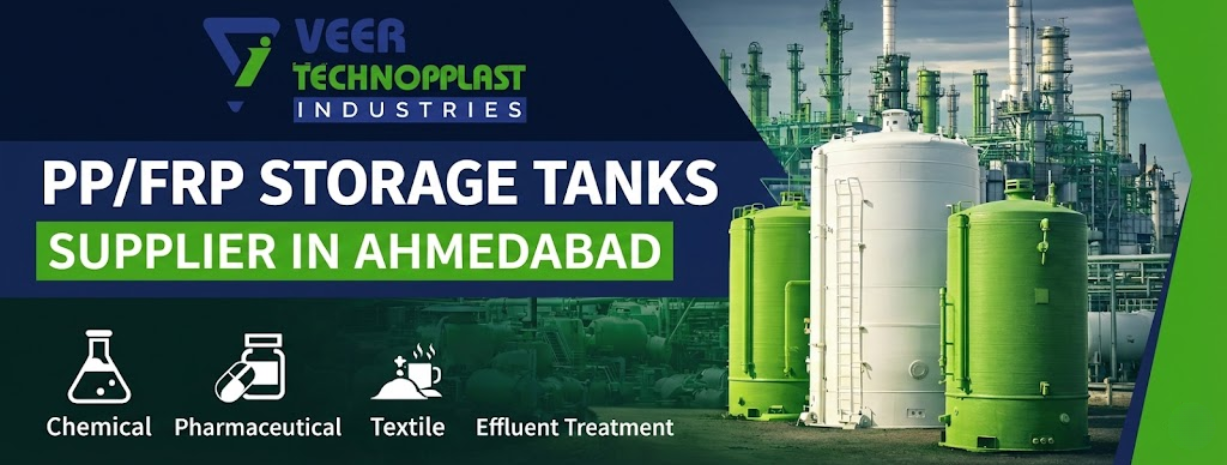
PP/FRP Storage Tanks Supplier in Ahmedabad

PP/FRP Storage Tanks
Supplier in Ahmedabad
Industrial operations involving chemical processing, surface treatment, effluent management, and liquid storage require materials capable of withstanding aggressive environments without deterioration.
PP/FRP Storage Tanks Supplier in Ahmedabad
A PP/FRP Storage Tanks supplier in Ahmedabad plays an essential role in supporting industries that demand long-term, corrosion-resistant, and structurally reliable storage systems. In applications where metallic tanks are prone to rust, scaling, and chemical attack, thermoplastic and composite alternatives provide a dependable solution.
Veer Technoplast Industries, based in Ahmedabad, Gujarat, manufactures thermoplastic storage systems engineered for industrial chemical handling. The company produces PP, HDPE, and FRP-based tanks that align with industrial safety standards and are designed for consistent operational performance. Its product range serves chemical processing, water treatment, electroplating, pharmaceutical manufacturing, textile processing, and related industries.
Understanding PP/FRP Storage Tank Construction
PP/FRP storage tanks combine the chemical resistance of polypropylene with the structural reinforcement of fiber-reinforced plastic. The polypropylene inner layer provides direct resistance against corrosive substances such as acids, alkalis, and solvents. The external FRP layer enhances mechanical strength, impact resistance, and dimensional stability.
This dual-material construction offers clear technical advantages. Polypropylene ensures compatibility with aggressive media, while FRP improves load-bearing capacity and structural rigidity. The result is a storage system suitable for both indoor and outdoor installations, capable of performing under varied industrial conditions without structural compromise. Within Ahmedabad's concentrated industrial ecosystem, this composite tank design supports safe storage practices while reducing long-term maintenance concerns.
Material Properties and Industrial Compatibility
Polypropylene is widely used for chemical storage due to its non-reactive properties and resistance to a broad spectrum of industrial liquids. It performs effectively within temperature ranges commonly encountered in processing environments. When reinforced with FRP, the overall tank structure gains enhanced resistance to mechanical stress, wind loads, and deformation.
PP/FRP tanks are suitable for storing:
- Mineral and dilute acids
- Alkalis and alkaline solutions
- Process chemicals and intermediates
- Effluent and wastewater streams
- Dyes, solvents, and treatment chemicals
This material combination minimizes contamination risk, prevents corrosion-related failures, and extends operational service life, particularly in facilities handling aggressive media on a daily basis.
Why Ahmedabad Industries Require Corrosion-Resistant Tanks
Ahmedabad hosts diverse industrial sectors, including chemicals, textiles, electroplating, pharmaceuticals, and surface treatment facilities. These industries depend on secure liquid storage systems that comply with safety requirements and withstand corrosive exposure.
In such settings, metallic tanks may corrode internally, increasing the risk of leakage and maintenance downtime. PP/FRP storage tanks address these challenges through rust-free construction and leak-resistant welding techniques. Their lightweight yet durable design also simplifies installation compared to conventional metal alternatives.
With increasing regulatory focus on environmental safety and responsible chemical handling, industries across Gujarat are progressively adopting polymer-based storage systems to enhance compliance and operational reliability.
Design Variations and Custom Engineering
A PP/FRP Storage Tanks supplier in Ahmedabad typically offers multiple configurations to suit plant layouts and process demands. These include vertical cylindrical tanks, horizontal tanks, rectangular units, flat-bottom tanks, and conical-bottom tanks designed for complete drainage.
Engineering specifications may involve customized wall thickness based on stored chemical properties, temperature exposure, and hydrostatic pressure. Accessory integration is equally important in industrial installations. Tanks can be equipped with nozzles, manholes, drain valves, level indicators, and structural supports tailored to operational requirements. Such customization ensures that storage systems integrate seamlessly with process flow design and safety planning within chemical plants and treatment facilities.
Manufacturing Processes Used in PP/FRP Tanks
The fabrication of PP/FRP tanks involves advanced thermoplastic processing and composite reinforcement methods. Depending on capacity and design, manufacturing may include:
- Spiral winding for large-capacity cylindrical tanks
- Butt-fusion welding for thermoplastic sheet construction
- FRP lamination over PP structures for structural reinforcement
- Structural ribbing to enhance mechanical strength
Quality control throughout fabrication ensures consistent wall thickness, precise weld joints, and leak-proof integrity. Established industrial guidelines for chemical storage are followed to maintain performance standards.
Applications Across Industrial Sectors
PP/FRP storage tanks serve a wide range of industrial applications in Ahmedabad and across Gujarat.
Chemical Processing Units
They are used for storing raw chemicals, intermediates, and finished liquid products that require non-reactive containment.
Effluent Treatment Plants
They support the handling of process water, neutralization chemicals, sludge liquids, and treated effluents in ETP and STP systems.
Electroplating and Surface Treatment
They store pickling acids, degreasing solutions, plating chemicals, and rinse water without corrosion-related degradation.
Pharmaceutical Manufacturing
They provide hygienic storage for liquid intermediates and processing media in alignment with industrial cleanliness requirements.
Textile and Dyeing Industries
They enable safe containment of dyes, auxiliaries, and chemical mixtures used in textile processing.
Agriculture and Fertilizer Storage
They are used for storing liquid fertilizers, agrochemicals, and irrigation treatment solutions.
These applications highlight the adaptability of PP/FRP tanks across diverse industrial sectors.
Operational Benefits of PP/FRP Storage Systems
When evaluating industrial storage solutions, durability and operational efficiency remain primary considerations. PP/FRP tanks offer practical functional advantages:
- Corrosion-resistant internal surfaces
- Rust-free, maintenance-friendly structure
- Lightweight construction for simplified installation
- Long service life in harsh chemical environments
- Broad chemical compatibility
- Reduced risk of contamination
These characteristics contribute to long-term plant reliability and minimize unexpected downtime caused by material degradation.
Temperature and Structural Performance
Polypropylene typically tolerates temperatures up to 80–90°C, depending on chemical compatibility, while FRP reinforcement enhances external structural stability. This combination enables tanks to operate under standard industrial temperature conditions without material failure.
Structural calculations consider hydrostatic pressure, wind loads, and stored liquid density. Proper engineering ensures safe performance even in high-capacity installations exceeding several thousand liters. Under Ahmedabad's climatic conditions, the use of UV-stabilized materials further extends outdoor tank life and preserves structural integrity over time.
Safety and Compliance Considerations
Industrial storage tanks must comply with chemical handling standards and environmental safety regulations. Leak prevention, chemical compatibility evaluation, and proper ventilation planning are integral aspects of tank design.
PP/FRP storage systems help reduce the risk of corrosion-induced leakage, which can otherwise result in environmental hazards. Their non-metallic construction eliminates rust contamination, promoting cleaner storage conditions.
Many facilities also incorporate secondary containment systems and level monitoring devices to enhance operational safety.
How to Evaluate a PP/FRP Storage Tanks Supplier in Ahmedabad
Selecting the appropriate supplier requires technical assessment rather than promotional comparison. Important factors include experience in thermoplastic and FRP fabrication, capability to customize tank dimensions and fittings, compliance with recognized industrial storage standards, in-house manufacturing infrastructure, and documented quality control procedures.
A technically competent manufacturer ensures that the storage solution aligns with chemical characteristics and plant-specific requirements.
Future Trends in Polymer Storage Solutions
Industrial infrastructure across Gujarat continues to evolve, with increasing emphasis on corrosion-resistant materials. Polymer-based storage systems are steadily replacing conventional metallic tanks due to improved lifecycle efficiency and lower maintenance requirements.
Advancements in composite reinforcement, welding precision, and material technology are further enhancing durability and performance. As industrial expansion continues in Ahmedabad, demand for engineered PP/FRP storage tanks is expected to remain consistent.
Frequently Asked Questions
PP/FRP tanks combine chemical resistance with structural reinforcement. Polypropylene resists reaction with corrosive liquids, while FRP provides mechanical strength. This combination supports the safe storage of acids, alkalis, and industrial chemicals.
Yes. When manufactured with UV-stabilized materials and appropriate structural reinforcement, they are suitable for outdoor industrial environments.
Capacities typically range from a few hundred liters to more than 50,000 liters, depending on design specifications and fabrication requirements.
They are produced using thermoplastic sheet welding, spiral winding, and FRP lamination techniques. The specific method depends on tank size, shape, and application.
Yes. Tanks can be engineered with nozzles, manholes, drain ports, ladders, and level gauges according to plant process requirements.
Due to their corrosion-resistant and rust-free construction, maintenance needs are generally lower compared to conventional metal tanks.
Conclusion
A PP/FRP Storage Tanks supplier in Ahmedabad supports essential industrial operations by providing corrosion-resistant and structurally reinforced storage systems. In chemical, pharmaceutical, textile, and water treatment industries, material reliability directly influences operational safety and efficiency. The combination of polypropylene and FRP reinforcement delivers balanced chemical compatibility and mechanical durability. As industries across Gujarat continue to prioritize long-term performance and environmental responsibility, polymer-based storage solutions remain a key component of modern industrial infrastructure.
Quick Links
Get In Touch
Plot No :- 83, Jyot Industrial Park, Bakrol-dhamatwan Road, Bakrol Bujrang, Ahmedabad, Gujarat -382430
info@veertechnoplast.com
+91 98798 75986
+91 70430 43070
VEER TECHNOPLAST INDUSTRIES | All Rights Reserved.