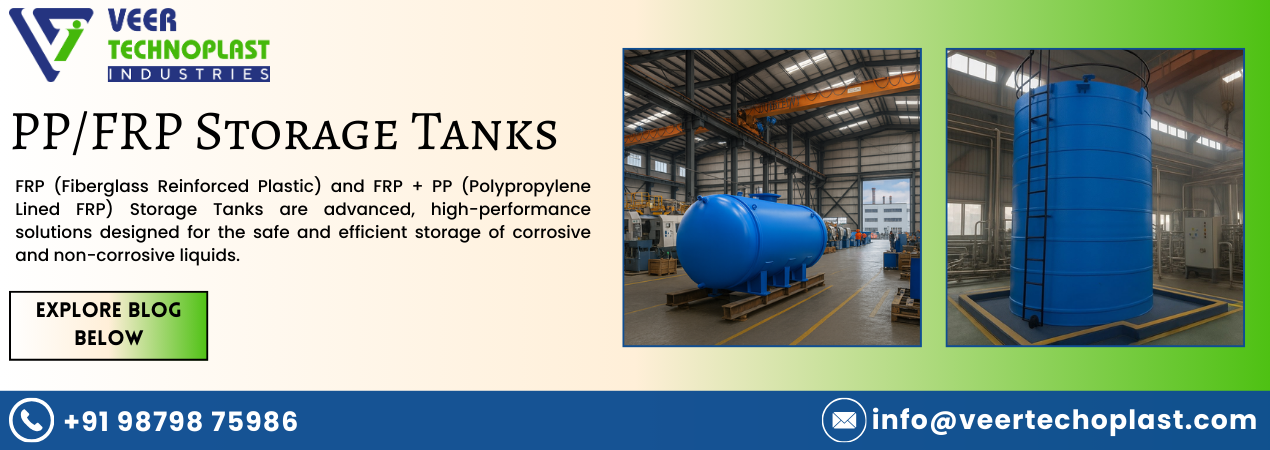
Corrosion-Resistant Storage Built for Industrial Reliability
PP/FRP storage tanks are industrial containers engineered for safe, stable storage of corrosive and non-corrosive
liquids. In Ahmedabad—where chemical processing, electroplating, pharmaceuticals, textiles, and water treatment
are strongly established—the need for corrosion-resistant storage solutions continues to rise. These tanks combine
the structural strength of Fiberglass Reinforced Plastic (FRP) with the chemical resistance of Polypropylene (PP),
helping industries maintain long service life, consistent performance, and operational safety in demanding
environments.
Veer Technoplast Industries manufactures plastic process equipment and storage systems, including PP, HDPE, PVC,
and FRP-based tanks. Operating from Ahmedabad, Gujarat, the focus remains on engineering storage solutions that
meet functional, safety, and operational requirements across multiple industries while maintaining material
integrity and predictable performance over time.
Why Ahmedabad Continues to Prefer PP/FRP Storage Systems
Ahmedabad is a major industrial hub with strong activity in chemical manufacturing, pharmaceuticals, textiles,
metal treatment, and water management. Many of these sectors routinely handle acids, alkalis, solvents, and
reactive liquids that can degrade conventional metal tanks. PP/FRP storage tanks provide a dependable non-metallic
alternative by offering corrosion resistance without typical concerns such as rusting, scaling, or chemical
deterioration.
Another practical advantage for industrial estates in and around Ahmedabad is handling efficiency. PP/FRP tanks
are comparatively lightweight, which supports easier transportation, lifting, and installation than heavier steel
structures. Combined with custom dimensional flexibility, they can be integrated into varied plant layouts while
keeping long-term maintainability and operational stability in view.
Understanding PP/FRP Tank Construction
PP/FRP storage tanks are commonly manufactured as dual-laminate structures. The outer layer is FRP, designed for
mechanical strength, rigidity, and load-bearing capacity. The inner layer is Polypropylene, which functions as a
chemical barrier and helps protect the tank from corrosion, chemical attack, and contamination. This construction
supports aggressive chemical storage while maintaining structural stability across an extended service life.
PP liner selection depends on chemical compatibility, operating temperature, and process conditions. The FRP layer
is engineered according to tank size, capacity, and installation environment. Together, this approach makes PP/FRP
tanks a reliable option for continuous operation in chemically harsh industrial conditions.
Materials Used in PP/FRP Storage Tanks
Tank reliability depends heavily on material selection. Polypropylene is widely used for resistance to a broad
range of chemicals, including many acids and alkalis. Its smooth internal surface supports easier cleaning,
reduces residue buildup, and helps maintain consistent handling conditions during storage and transfer operations.
Fiberglass Reinforced Plastic forms the external structure and contributes a favorable strength-to-weight ratio
along with resistance to moisture and outdoor exposure. In the FRP layer, resin systems can be chosen according to
temperature limits and chemical exposure, supporting compatibility with specific industrial processes and
installation environments.
Design and Customization Capabilities
PP/FRP storage tanks are not limited to standard designs. They are available in configurations such as vertical
cylindrical, horizontal cylindrical, rectangular, flat-bottom, and conical-bottom tanks. Selection typically
depends on space availability, liquid characteristics, and process integration requirements within the facility.
Customization may include nozzle placement, manholes, drain connections, venting arrangements, ladders, platforms,
and level indicators. Wall thickness and reinforcements are engineered based on tank capacity, operating
conditions, and chemical characteristics. This flexibility helps industries in Ahmedabad integrate PP/FRP tanks
into existing layouts with fewer compromises.
Applications of PP/FRP Storage Tanks in Ahmedabad
PP/FRP storage tanks are widely adopted across industries where chemical resistance, durability, and consistent
operating behavior matter. Common application areas include:
Chemical manufacturing for acids, alkalis, solvents, and intermediate chemicals
Electroplating, anodizing, and pickling plants handling aggressive treatment
solutions
Effluent treatment and wastewater systems for chemical dosing and liquid storage
Pharmaceutical and biotechnology units where compatibility and contamination control
are critical
Textile, dye, pigment, and paper industries for process chemicals and handling
stages
Food, beverage, and dairy sectors for non-reactive liquid storage with hygiene focus
Performance Advantages in Industrial Environments
PP/FRP storage tanks are selected not only for chemical resistance, but also for stable day-to-day operation in
active plants. Key advantages typically include:
Corrosion resistance for aggressive chemicals and continuous exposure
Non-metallic construction that avoids rust-related contamination risks
Low maintenance profile that supports reduced downtime over the lifecycle
UV-stabilized FRP outer layers suitable for outdoor installations
Smooth PP liner surface that helps minimize residue and simplifies cleaning
Weight advantage supporting easier handling, lifting, and on-site positioning
Temperature and Capacity Considerations
PP/FRP storage tanks are designed to operate within defined temperature ranges based on liner selection and FRP
resin systems. Polypropylene liners are commonly chosen for operating ranges that may reach approximately 70–90°C,
while FRP structures can tolerate higher external exposure depending on formulation. These parameters should be
evaluated during design to ensure predictable performance and safety in real operating conditions.
Capacities can vary from compact, process-support tanks to large industrial storage systems holding tens of
thousands of liters. In Ahmedabad’s industrial environment, both small footprint tanks and high-capacity
installations are used, typically selected by process demand, available space, and safety planning requirements.
Installation and Site Requirements
Installation quality directly influences performance and service life. Foundations should be level and capable of
supporting full operating load. Outdoor installations may require additional engineering for wind loads and
seismic stability, particularly for taller vertical tanks in open yard conditions.
Where possible, piping connections, supports, and key accessories are integrated during fabrication to reduce
on-site modifications. This approach improves installation efficiency and helps lower risks related to leakage,
misalignment, or structural stress during commissioning and routine operation.
Quality and Manufacturing Practices
Manufacturing typically involves controlled processes such as hand lay-up or filament winding for FRP structures
and precision welding for PP liners. Each stage focuses on dimensional accuracy, joint integrity, and reliable
bonding between layers to support long-term structural and chemical performance.
Common quality checks include visual inspection, dimensional verification, and leak testing where applicable.
Alignment with industrial chemical storage guidelines supports safer operation and helps ensure that the tank
meets both functional and long-term reliability expectations in real plant conditions.
Choosing PP/FRP Storage Tanks in Ahmedabad
Selecting a PP/FRP tank is usually a fit-for-process decision. Industries commonly evaluate chemical
compatibility, capacity requirements, installation conditions, and maintenance expectations to ensure the tank
aligns with present operations and future process needs.
Assess chemical type and operating temperature to determine liner and resin
suitability
Confirm available space and layout constraints before finalizing tank orientation
and shape
Review nozzle, manhole, drain, venting, and level-indication requirements during
design
Check support needs for piping and accessories to avoid undue stress on connections
Ensure the design supports foreseeable expansion or process changes without major
rework
Role of PP/FRP Tanks in Sustainable Industrial Operations
Non-metallic storage systems support sustainable industrial practices by offering long service life and reducing
frequent replacement needs. Corrosion resistance lowers the likelihood of leakage and helps protect against
avoidable environmental contamination. Their lighter construction can also reduce transportation energy compared
with heavier metal alternatives.
In industrial regions like Ahmedabad—where compliance expectations and operational efficiency are increasingly
important—PP/FRP storage tanks remain a practical option for safe liquid handling with predictable maintenance
requirements and long-term performance stability.
Frequently Asked Questions
FRP tanks are constructed entirely from fiberglass reinforced plastic, while PP/FRP tanks use a polypropylene
liner inside an FRP outer structure. The liner improves chemical resistance when handling more aggressive media.
Yes. With UV-stabilized FRP layers and proper engineering for site conditions, PP/FRP tanks can be installed
outdoors for long-term use in industrial environments.
PP/FRP storage tanks can be customized for size, shape, wall thickness, fittings, and accessories to match
process requirements and layout constraints.
Chemical processing, electroplating, pharmaceuticals, textiles, water treatment, and food processing commonly
use PP/FRP tanks in the Ahmedabad region due to chemical resistance and durability needs.
Service life depends on operating conditions, chemical exposure, and inspection practices. With correct design
and appropriate use, PP/FRP tanks can deliver long-term reliable performance.
Maintenance is generally minimal. Periodic checks for physical damage, connection integrity, and liner condition
are usually sufficient to keep performance stable.