

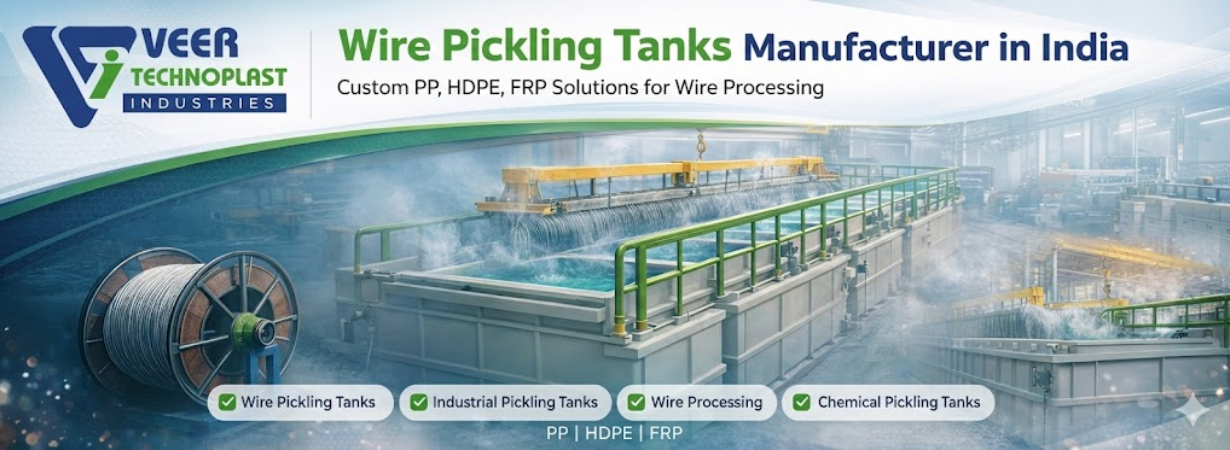
India's wire processing and metal manufacturing sectors depend on controlled surface treatment systems to achieve consistent quality, mechanical strength, and compatibility with downstream processes. Among these systems, wire pickling tanks play a vital role in removing scale, oxides, and surface contaminants formed during rolling, drawing, or heat treatment. For industries seeking a reliable wire pickling tanks manufacturer in India, the focus has moved beyond basic fabrication to include chemical compatibility, long-term durability, operational safety, and alignment with modern industrial standards.
With expansion across steel, construction, automotive, and infrastructure sectors, demand for engineered pickling solutions continues to rise. Wire pickling tanks are now expected to operate reliably under aggressive chemical conditions while supporting efficient production workflows and responsible environmental practices.
Understanding wire pickling tanks and their industrial role
Wire pickling tanks are chemical treatment vessels designed to clean metal wire surfaces by dissolving rust, mill scale, oxides, and residues using controlled acid solutions. These tanks form part of an integrated pickling line that typically includes degreasing, acid treatment, water rinsing, and neutralization stages. The objective is to achieve a uniform, contaminant-free wire surface before further processing.
In wire drawing, galvanizing, coating, and electroplating operations, surface cleanliness directly influences product performance. Inadequate pickling can lead to coating failures, reduced tensile strength, uneven finishes, and higher rejection rates. Well-engineered wire pickling tanks help maintain consistent surface quality while minimizing material loss and rework.
Material selection and chemical compatibility considerations
Material selection is one of the most critical factors in wire pickling tank manufacturing. Pickling processes involve highly corrosive acids such as hydrochloric acid, sulfuric acid, or blended solutions. Tank materials must withstand continuous chemical exposure without deformation, leakage, or structural failure.
Wire pickling tanks in India are commonly manufactured using polypropylene (PP), high-density polyethylene (HDPE), fiber-reinforced plastic (FRP), or composite PP+FRP constructions. Each option offers specific advantages depending on operating temperature, chemical concentration, and process intensity.
PP and HDPE provide strong resistance to most pickling acids and are suitable for moderate-temperature applications. FRP offers additional structural strength, making it suitable for larger tanks and continuous-duty operations. Composite PP+FRP designs combine chemical resistance with mechanical reinforcement, supporting longer service life in demanding environments.
Structural design and operational reliability
Beyond material choice, structural engineering significantly affects long-term performance. Wire pickling tanks are exposed to repeated filling and draining cycles, thermal expansion, and mechanical loads from wire handling systems. Inadequate design can result in deformation, cracking, or premature failure.
High-quality wire pickling tanks manufactured in India feature uniform wall thickness, reinforced ribs, and properly supported bases. Smooth internal surfaces promote uniform acid circulation and reduce residue buildup that can disrupt bath chemistry. Well-designed inlet, outlet, overflow, and drainage systems help maintain stable chemical conditions and safe operation.
Custom sizing and layout integration
Wire pickling requirements vary based on wire diameter, line speed, and production volume. As a result, standard tank sizes may not suit modern processing plants. Custom-built wire pickling tanks allow seamless integration into both existing and new production lines.
Customization typically includes adjustments to tank length, width, depth, and reinforcement based on wire travel paths and immersion time. Indian manufacturers increasingly deliver tailored solutions that align with plant layouts, automation systems, and fume management arrangements.
Safety and environmental considerations
Pickling operations involve hazardous chemicals, making safety and containment essential. Wire pickling tanks must be designed to reduce leakage risks, control fumes, and limit operator exposure. Compatibility with fume extraction systems, chemical-resistant covers, and controlled overflow arrangements contributes to safer working conditions.
Environmental compliance is equally important. Proper tank design supports efficient acid usage, limits evaporation losses, and simplifies integration with effluent treatment systems. This supports regulatory compliance and sustainability objectives across industrial zones in India.
Applications across Indian industries
Wire pickling tanks are used across a wide range of industrial segments, supporting both primary production and downstream processing activities.
- Steel wire drawing units where surface preparation is critical for dimensional accuracy and strength
- Galvanizing plants that prepare wires for coating by creating clean, reactive surfaces
- Automotive and construction sectors for fasteners, cables, springs, spokes, and reinforcement products
- Electroplating and coating facilities to improve adhesion and surface finish quality
Key functional benefits of engineered wire pickling tanks include:
- Consistent removal of rust, scale, and oxides
- Improved wire surface uniformity
- Reduced coating defects and rework
- Enhanced process efficiency and throughput
- Long-term resistance to chemical corrosion
Manufacturing standards and quality practices
A dependable wire pickling tanks manufacturer in India follows established chemical processing and industrial safety practices. Manufacturing methods such as hot gas welding, butt-fusion welding, and FRP lamination are used to achieve leak-proof joints and reliable structural integrity. Material thickness is selected based on chemical aggressiveness, operating temperature, and tank capacity.
Quality control processes typically include raw material inspection, weld integrity checks, dimensional verification, and load analysis. These measures help ensure reliable performance under continuous industrial use and adherence to customer specifications.
Choosing the right wire pickling tank manufacturer in India
Selecting a suitable manufacturer involves more than evaluating product availability. Buyers should consider technical expertise, customization capability, and long-term support.
Important evaluation factors include:
- Experience in chemical-resistant tank fabrication
- Ability to customize tanks for specific wire processing requirements
- Use of proven materials and manufacturing techniques
- Understanding of industrial safety and environmental compliance
- Support for installation guidance and future modifications
Manufacturers located in established industrial regions such as Gujarat often benefit from access to skilled labor, raw materials, and logistics infrastructure, supporting consistent quality and dependable delivery timelines.
Wire pickling tanks and future industrial trends
As Indian manufacturing continues to modernize, wire processing facilities are adopting automation, higher throughput systems, and stricter quality controls. Wire pickling tanks are evolving accordingly, with designs that support automated handling, process monitoring, and improved fume control.
Sustainability is also shaping future tank design, encouraging efficient chemical usage, extended service life, and compatibility with wastewater treatment systems. These trends position wire pickling tanks as long-term process assets rather than simple containment units.
Wire pickling tanks are a critical component of India's wire processing and metal manufacturing infrastructure. Their role extends beyond surface cleaning to supporting product quality, process efficiency, and workplace safety. For industries evaluating a wire pickling tanks manufacturer in India, priority should be given to material compatibility, engineering quality, customization capability, and adherence to industrial standards.
As manufacturing requirements continue to evolve, investing in well-designed wire pickling tanks helps ensure consistent production outcomes and long-term operational reliability across diverse industrial applications.


