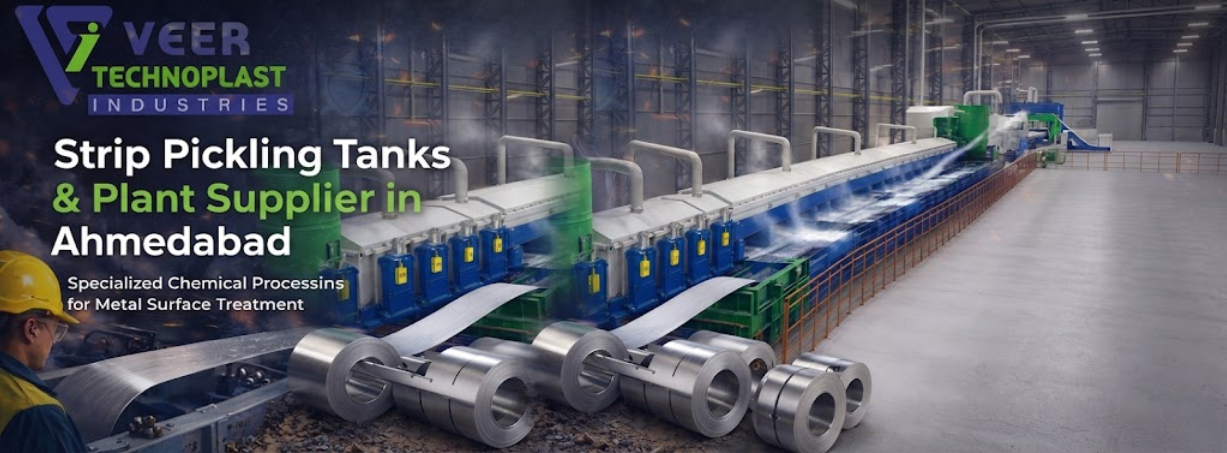
Strip pickling tanks and plants play a critical role in modern metal processing industries where surface quality, consistency, and compatibility with downstream processes are essential. In industrial hubs like Ahmedabad, where steel, stainless steel, aluminum, and fabrication units operate at scale, strip pickling systems form a foundational part of reliable metal preparation. This content explains how strip pickling tanks and plants function, why material selection is important, how these systems integrate into production lines, and what industries in Ahmedabad typically expect from a dependable strip pickling solution.
Understanding strip pickling tanks and plant systems
A strip pickling tank and plant is a structured chemical processing system used to remove scale, rust, oxides, and surface contaminants from metal strips. These impurities commonly develop during hot rolling, annealing, or heat treatment processes. If not removed effectively, they can affect coating adhesion, dimensional accuracy, corrosion resistance, and overall product performance.
Strip pickling systems are designed to treat metal strips through controlled chemical reactions, either in continuous or batch operations. The process ensures the metal surface becomes clean and uniform, making it suitable for subsequent operations such as galvanizing, coating, painting, cold rolling, or forming.
In Ahmedabad's industrial environment, strip pickling plants are frequently integrated into steel processing units, pipe and tube manufacturing facilities, and surface treatment lines that require consistent results and stable operation.
How strip pickling plants work in industrial operations
A typical strip pickling plant operates through a sequence of interconnected tanks and controlled process stages. Each stage is engineered to achieve a specific surface treatment objective while maintaining chemical balance and operational safety.
The process generally includes degreasing to remove oils and surface residues, acid pickling to dissolve scale and oxide layers, water rinsing to remove acid carryover, and neutralization to stabilize the metal surface. These stages can be configured for continuous strip processing or batch-based operations, depending on production volume, strip dimensions, and process requirements.
In Ahmedabad-based facilities, layout flexibility is particularly important due to space limitations and the need to integrate new systems into existing production lines.
Material selection for strip pickling tanks
The performance and service life of a strip pickling tank depend heavily on material selection. Pickling processes involve aggressive acids such as hydrochloric acid, sulfuric acid, or mixed acid formulations, often operating at elevated temperatures. Tanks must therefore provide long-term chemical resistance along with mechanical stability.
Commonly used materials include polypropylene, high-density polyethylene, fiber reinforced plastic, and PP plus FRP composite constructions. Each material is selected based on acid concentration, operating temperature, and structural requirements.
Polypropylene tanks are widely used for their chemical resistance, smooth internal surfaces, and fabrication flexibility. HDPE tanks offer higher impact strength and improved thermal stability for demanding applications. FRP reinforcement enhances structural rigidity, particularly for larger tanks or installations exposed to external stress. Composite PP plus FRP constructions combine chemical resistance with mechanical strength and are often preferred for continuous strip pickling plants operating on extended duty cycles.
Why corrosion resistance and structural design matter
In strip pickling operations, even minor leakage or structural deformation can lead to process instability, safety concerns, and unplanned downtime. For this reason, tank design focuses on leak-proof construction, consistent wall thickness, and appropriate reinforcement.
Manufacturing techniques such as hot gas welding, butt fusion welding, FRP lamination, and spiral fabrication are used to ensure joint integrity and dimensional accuracy. Smooth internal surfaces help prevent chemical buildup and contamination, while external stiffeners and support frames maintain tank geometry under operational loads.
For industrial units in Ahmedabad that experience high ambient temperatures and variable operating conditions, UV resistance and thermal shock tolerance are also important design considerations.
Integration with fume control and safety systems
Strip pickling processes generate acidic fumes that must be managed to maintain workplace safety and environmental compliance. Modern strip pickling plants are designed to integrate with fume extraction systems, acid fume scrubbers, and ventilation networks.
Pickling tanks can be equipped with safety covers, fume hoods, dosing systems, overflow arrangements, and controlled drainage to ensure safe chemical handling. Proper integration helps reduce corrosion of surrounding equipment and supports adherence to industrial safety practices commonly followed in Ahmedabad-based manufacturing facilities.
Customization based on strip size and process requirements
Strip pickling operations vary widely depending on strip width, thickness, processing speed, and chemical concentration. As a result, strip pickling tanks and plants are typically custom-designed rather than standardized.
Tank dimensions, wall thickness, reinforcement methods, and accessory configurations are tailored to specific process parameters. Heating coils may be incorporated for hot pickling applications, while additional rinsing stages can be included where higher surface cleanliness is required.
Customization allows manufacturers in Ahmedabad to optimize chemical usage, reduce material loss, and maintain consistent surface quality across production batches.
Industries using strip pickling tanks and plants in Ahmedabad
Ahmedabad has a diverse industrial base that relies heavily on surface treatment technologies. Strip pickling systems are used across multiple sectors where metal surface quality directly affects product performance.
Typical applications include steel and stainless steel strip manufacturing, automotive component production, pipe and tube manufacturing units, galvanizing and coating plants, fabrication and metal finishing industries, and heat treatment or forging facilities. In each of these applications, pickling supports improved weldability, coating adhesion, and corrosion resistance.
Benefits of well-designed strip pickling systems
A properly engineered strip pickling tank and plant delivers operational advantages beyond basic surface cleaning. These benefits influence production efficiency, quality consistency, and maintenance requirements.
- Uniform removal of scale and oxides
- Improved compatibility with downstream processes
- Reduced chemical loss
- Lower contamination risk
- Extended service life
- Stable performance under continuous industrial operation
For manufacturers in Ahmedabad, these outcomes support predictable production quality and reduced operational interruptions.
Why Ahmedabad-based industries require specialized solutions
Ahmedabad's industrial environment presents specific challenges such as high production volumes, space constraints, and varied processing needs across sectors. Strip pickling systems must be designed with these local conditions in mind.
Factors such as access to skilled fabrication resources, proximity to chemical suppliers, and familiarity with regional safety norms influence system design and installation. Availability of local service support and customization capability also contributes to long-term reliability, making locally adapted solutions preferable for many Ahmedabad-based industries.
Quality standards and manufacturing considerations
Strip pickling tanks and plants are manufactured in accordance with industrial chemical processing and safety requirements. While standards vary by application, consistent quality control during fabrication remains essential.
Manufacturing attention focuses on weld quality, material traceability, dimensional precision, and proper integration of accessories. These considerations help ensure reliable performance over extended service periods without compromising safety or process efficiency.
Conclusion
Strip pickling tanks and plants form an essential part of metal processing infrastructure, particularly in industrial centers such as Ahmedabad. By ensuring clean and uniform metal surfaces, these systems support consistent quality, efficient processing, and reliable downstream operations across multiple manufacturing sectors. Understanding system design, material selection, and process integration helps businesses make informed decisions aligned with long-term operational requirements.