

Industrial storage systems play an important role in chemical handling, water treatment, pharmaceutical processing, textile operations, electroplating, food processing, and many other production environments.
When liquids are corrosive, reactive, acidic, alkaline, or sensitive to contamination, choosing the right tank material becomes a critical decision. This is why many industries prefer polypropylene tanks for safe, long-lasting, and low-maintenance storage.
A PP tank supplier in Gujarat supports industries that need durable, corrosion-resistant, and application-specific storage tanks for different process requirements. Gujarat has a strong industrial base that includes chemical, pharmaceutical, textile, engineering, water treatment, plastic processing, and agrochemical sectors. These industries often require tanks that can handle aggressive liquids without rusting, leaking, or reacting with stored materials.
Veer Technoplast Industries is based in Ahmedabad, Gujarat, and works in industrial plastic fabrication solutions. The company provides PP tanks, HDPE tanks, PP/FRP storage tanks, PP/HDPE storage tanks, PVC/PVDF tanks, spiral tanks, ducting systems, blowers, pickling tanks, scrubber systems, lab hoods, ETP plant-related solutions, and other industrial plastic products. For businesses looking for PP tanks in Gujarat, understanding tank construction, material performance, applications, and selection factors can help in choosing the right storage solution.
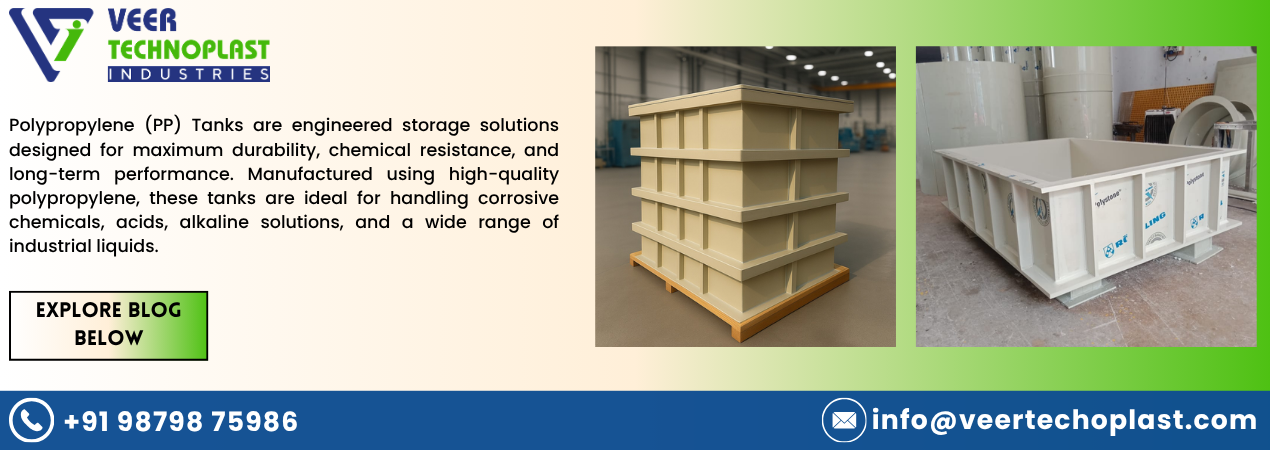
A PP tank is a storage tank manufactured using polypropylene material. Polypropylene is widely used in industrial applications because it offers strong chemical resistance, low moisture absorption, lightweight handling, and good mechanical strength. Unlike mild steel tanks, PP tanks do not rust. They also do not easily react with many acids, alkalis, solvents, and corrosive industrial liquids when selected according to chemical compatibility.
PP tanks are commonly used where chemical resistance, hygiene, leak resistance, and easy maintenance are important. They can be fabricated in vertical cylindrical, horizontal, rectangular, spiral, or customized shapes depending on site layout, liquid type, storage capacity, and operational requirements.
These tanks are generally manufactured through sheet fabrication, spiral construction, extrusion welding, or fusion welding methods. Proper welding quality is important because it helps the tank remain leak-proof during long-term use. Depending on the chemical type and tank size, wall thickness, fittings, reinforcement, support structure, and optional FRP lining can also be customized.
Industries in Gujarat often handle chemicals, process liquids, treatment chemicals, acidic solutions, alkaline materials, and industrial effluents. In such environments, storage tanks must perform safely under practical working conditions. PP tanks are preferred because they offer a useful balance of chemical resistance, durability, and low-maintenance performance.
Polypropylene tanks are lightweight compared to many traditional storage tanks, making installation, shifting, and maintenance easier. Their smooth internal surface helps reduce contamination risk and supports easier cleaning. For industries where stored liquids must remain stable and uncontaminated, this feature becomes highly useful.
Another important reason behind the demand for PP tanks is their resistance to rust and corrosion. In chemical and water treatment environments, metal tanks may require regular coating, surface protection, or maintenance. PP tanks reduce such concerns because the base material itself is corrosion-resistant for many compatible chemicals.
PP tanks are selected for different industrial applications because of their functional design and material advantages. The most useful features include:
Gujarat has many industries where PP tanks are used as part of daily production, storage, treatment, and chemical handling systems. The tank design may differ from one industry to another, but the core requirement remains the same: safe and reliable liquid storage.
PP tanks are widely used in chemical processing units for storing acids, alkalis, dosing chemicals, process liquids, and intermediate materials. Their chemical resistance helps industries handle reactive liquids with better safety and operational control.
ETP, STP, RO, and DM water systems often require tanks for chemical dosing, neutralization, buffer storage, and liquid collection. PP tanks are suitable for these systems because they can handle many treatment chemicals and wastewater-related applications.
Pharmaceutical units require clean, non-contaminating, and easy-to-maintain storage solutions. PP tanks are used in selected pharmaceutical liquid handling applications where material compatibility and hygienic surfaces are important.
Textile and dye industries use different chemicals, colors, and process liquids. PP tanks help store and handle such liquids in production lines, treatment sections, and chemical preparation areas.
Electroplating, anodizing, chrome plating, and pickling-related applications often involve acidic or alkaline solutions. PP tanks are used in these environments because of their corrosion resistance and compatibility with many process chemicals.
PP tanks can be used for suitable fertilizer, pesticide, and agrochemical storage applications where chemical resistance and leak-proof performance are required.
For compatible non-reactive liquids, PP tanks may be used in food-processing environments where cleanliness, smooth surfaces, and material suitability matter. Food-grade options can be selected based on specific application needs.
PP tanks can also be used as reaction tanks, mixing tanks, neutralization tanks, and buffer tanks when designed according to liquid properties, temperature, agitation needs, and process requirements.
A PP tank should not be selected only by capacity. Tank performance depends on liquid type, operating temperature, location, installation method, chemical compatibility, wall thickness, and fabrication quality. Common specification factors include:
| Material | High chemical resistance grade polypropylene |
| Construction | Spiral, extrusion welded, or sheet fabricated |
| Capacity | Customizable from small storage needs to large industrial tanks |
| Shape | Vertical cylindrical, horizontal, or rectangular |
| Wall Thickness | Based on tank size, liquid density, and application |
| Temperature Resistance | Suitable for defined industrial temperature ranges |
| Chemical Compatibility | Selected according to stored acids, alkalis, solvents, or liquids |
| UV Protection | Useful for outdoor installations |
| Reinforcement | FRP lining or external support for additional strength |
| Fittings | Nozzles, valves, flanges, manholes, drain points, and level indicators as required |
Choosing the right PP tank supplier is important because tank failure can affect production, safety, storage quality, and maintenance planning. A reliable supplier should understand industrial applications, chemical compatibility, fabrication methods, and site-specific requirements.
Before finalizing a PP tank, businesses should check practical factors such as:
A proper discussion of these factors helps avoid under-designed tanks, unsuitable material selection, leakage issues, and unnecessary operational downtime.
Gujarat is one of India's major industrial states, with strong demand from Ahmedabad, Vadodara, Surat, Vapi, Ankleshwar, Bharuch, Rajkot, Morbi, and nearby industrial areas. Many businesses in these regions work with chemicals, dyes, pigments, pharmaceuticals, wastewater treatment systems, plastic processing units, and fabrication plants.
In such sectors, storage tanks are not just containers. They are part of the production and safety system. A poorly selected tank may lead to corrosion, leakage, contamination, chemical loss, process interruption, or maintenance issues. This is why industries prefer polypropylene tanks designed according to chemical usage, capacity requirement, and installation conditions.
For companies searching for a PP tank supplier in Gujarat, the focus should be on practical performance, material compatibility, fabrication quality, customization, and long-term usability.
PP tanks are known for low maintenance, but correct handling and inspection are still important. Regular checks help maintain safe storage and extend tank service life. Operators should inspect welded joints, nozzles, fittings, support structures, and external surfaces at planned intervals.
Tanks installed outdoors should be checked for direct sunlight exposure, support condition, and UV protection suitability. If the stored chemical has a higher temperature or specific compatibility requirement, the tank should be selected accordingly before installation. Cleaning should be done using suitable procedures based on the stored liquid and industry practice.
Proper installation is also important. The tank should be placed on a stable foundation with correct support. Piping loads should not create stress on tank nozzles. Venting, overflow, drain systems, and safety access should be planned based on the application.
Every industry may not need the same tank design. Some businesses need small chemical dosing tanks, while others require large process storage tanks. Some plants need rectangular tanks to fit limited floor space, while others prefer vertical cylindrical tanks for efficient storage. Some applications require FRP reinforcement, while others may need additional fittings, inspection covers, or special outlet arrangements.
A customized PP tank helps industries improve installation efficiency and operational suitability. The tank can be designed according to capacity, available space, liquid properties, pipe connections, handling needs, and process flow. This makes PP tanks suitable for both new projects and replacement requirements in existing plants.
A PP tank supplier in Gujarat plays an important role in supporting industries that require safe, corrosion-resistant, and customized liquid storage systems. From chemical processing and water treatment to pharmaceutical, textile, electroplating, agrochemical, and food-processing applications, PP tanks offer practical benefits for many industrial environments.
Veer Technoplast Industries provides PP tanks and related industrial plastic fabrication solutions for businesses that need durable storage systems for compatible chemicals, process liquids, and treatment applications. By selecting the right tank material, construction method, capacity, fittings, and reinforcement, industries can improve storage safety, reduce maintenance concerns, and support smooth plant operations.
A PP tank is used for storing and handling chemicals, acids, alkalis, process liquids, wastewater treatment chemicals, pharmaceutical liquids, textile chemicals, dyes, pigments, and compatible industrial liquids. It is preferred where corrosion resistance, leak-proof construction, and low maintenance are required.
PP tanks are suitable for chemical storage because polypropylene offers resistance against many corrosive chemicals, acids, alkalis, and solvents. The material does not rust like metal tanks and provides a smooth internal surface that helps reduce contamination risk and supports easier cleaning.
Yes, PP tanks can be customized based on capacity, shape, wall thickness, fittings, nozzles, manholes, drain points, reinforcement, and installation layout. Customization depends on the liquid type, storage re
Veer Technoplast Industries manufactures durable, corrosion-resistant industrial tanks, scrubber systems, and advanced plastic engineering solutions.
2026 All Rights Reserved | Website by IndustryLead


