
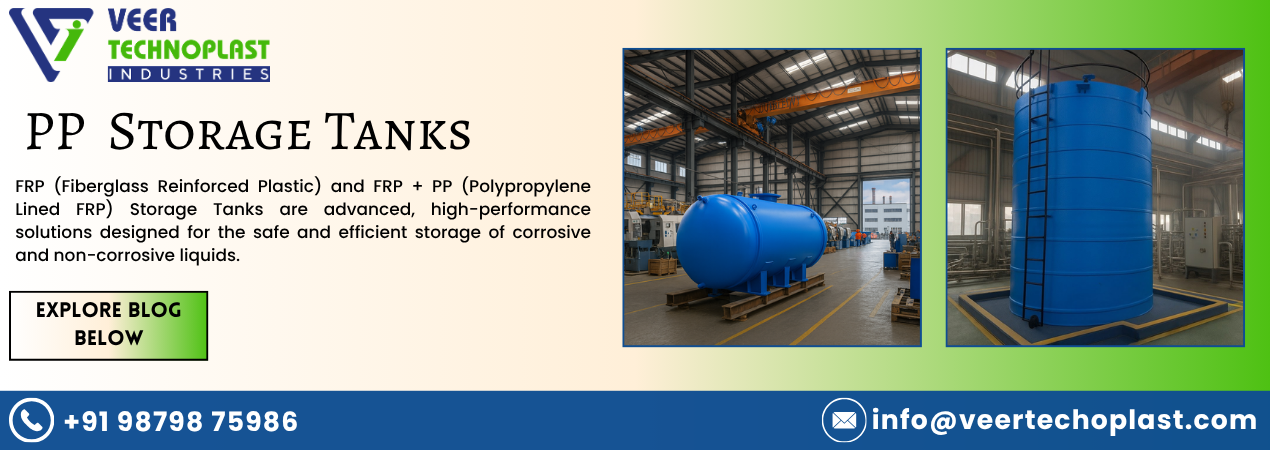
PP Storage Tank Manufacturer
A PP Storage Tank Manufacturer plays an important role in supporting industries that need safe, durable, and corrosion-resistant liquid storage solutions. Polypropylene storage tanks are widely used for storing chemicals, acids, alkalis, solvents, wastewater, process liquids, and other industrial fluids. These tanks are preferred because polypropylene offers excellent chemical resistance, lightweight handling, long service life, and low maintenance compared to many conventional storage materials.
In industrial environments, liquid storage is not only about capacity. It also involves material compatibility, structural strength, leak prevention, temperature suitability, safety, and long-term performance. A well-designed PP storage tank helps industries manage liquids more efficiently while reducing the risk of corrosion, contamination, leakage, and frequent replacement. This makes PP tanks a practical choice for chemical processing, water treatment, plating, pickling, pharmaceutical, textile, fertilizer, food processing, and various manufacturing applications.
Veer Technoplast Industries manufactures PP tanks, HDPE tanks, PP/FRP storage tanks, PP/HDPE storage tanks, PVC/PVDF tanks, spiral tanks, blowers, ducting systems, scrubber systems, pickling tanks, plating tanks, lab hoods, cabinets, and industrial process equipment. The company focuses on providing plastic and composite solutions designed for demanding industrial use where corrosion resistance, durability, and dependable performance are essential.
What Is a PP Storage Tank?
A PP storage tank is a storage vessel manufactured from polypropylene, a thermoplastic material known for its strong resistance to many acids, alkalis, and chemical solutions. These tanks are used to store liquids safely in industries where metal tanks may corrode or react with stored chemicals. Polypropylene tanks are suitable for both indoor and outdoor industrial installations, depending on the design, thickness, fittings, and application requirements.
The main purpose of a PP storage tank is to provide reliable containment for liquids that require chemical compatibility and safe handling. These tanks can be designed in different shapes, sizes, thicknesses, and capacities based on the nature of the liquid, storage volume, temperature conditions, installation area, and operational process. They may also include accessories such as manhole covers, nozzles, drain valves, level indicators, support structures, inlet-outlet connections, ladders, and platforms.
Why Industries Prefer Polypropylene Storage Tanks
Polypropylene is widely used in industrial tank manufacturing because it offers a balanced combination of chemical resistance, strength, flexibility, and cost-effective maintenance. Unlike mild steel and many other materials, PP does not rust, making it suitable for applications involving corrosive liquids. Its smooth inner surface also helps reduce scaling, residue buildup, and contamination risk.
A PP storage tank is especially useful where chemical reactions, moisture exposure, acidic fumes, or aggressive liquid handling are common. In such conditions, choosing the wrong tank material can lead to leakage, structural damage, frequent repairs, or operational downtime. Properly designed PP tanks help reduce these concerns when selected according to the stored liquid and working environment.
Key Features of PP Storage Tanks
PP storage tanks are designed to handle industrial storage needs with safety and durability. Their performance depends on tank design, fabrication quality, material grade, wall thickness, welding method, and application compatibility.
Common features include:
- Excellent resistance to acids, alkalis, and many industrial chemicals
- Rust-free construction suitable for corrosive environments
- Lightweight structure for easier handling and installation
- Leak-resistant fabrication with proper welding and joint finishing
- Custom capacity, diameter, height, and thickness options
- Smooth internal surface for cleaner liquid storage
- Low maintenance compared to many metallic tanks
- Suitable for process, storage, and treatment applications
- Option for fittings, valves, nozzles, and inspection openings
- Long service life when used with compatible chemicals
These features make PP tanks suitable for industries where reliable storage and corrosion protection are both important.
PP Storage Tank Design and Construction
A professional PP Storage Tank Manufacturer considers several technical factors before designing a tank. The stored liquid, chemical concentration, operating temperature, tank capacity, site condition, and usage frequency all affect the final design. Proper thickness selection and fabrication quality are important because industrial tanks must withstand liquid load, handling stress, and environmental conditions.
PP tanks can be manufactured in vertical cylindrical, horizontal, rectangular, conical bottom, flat bottom, and customized shapes. Vertical tanks are commonly used when floor space needs to be managed efficiently. Horizontal tanks may be selected for specific installation layouts or process requirements. Rectangular tanks are useful in treatment plants, plating lines, and process systems where space utilization and access are important.
For more demanding applications, PP tanks may also be combined with FRP reinforcement. In PP/FRP tanks, the PP inner layer provides chemical resistance, while the FRP outer layer adds mechanical strength and structural support. This combination is commonly selected where higher durability and enhanced load-bearing strength are required.
Applications of PP Storage Tanks
PP storage tanks are used across different industrial sectors because of their chemical compatibility and practical design flexibility. They are suitable for both storage and process-related functions.
Common applications include:
- Chemical storage for acids, alkalis, and process liquids
- Effluent treatment and wastewater handling systems
- Electroplating, pickling, and anodizing processes
- Textile dyeing and pigment processing units
- Pharmaceutical and laboratory liquid handling
- Fertilizer, pesticide, and agrochemical storage
- Food, beverage, and dairy liquid applications where compatible
- Paper, pulp, and surface treatment industries
- Water treatment plants and dosing systems
- Industrial solvent and non-corrosive liquid storage
The suitability of a PP tank depends on the chemical type, concentration, temperature, exposure time, and storage conditions. A proper compatibility check is always important before finalizing the tank material.
Benefits of Choosing the Right PP Storage Tank Manufacturer
Selecting the right manufacturer is essential because tank quality directly affects safety, performance, and long-term reliability. A well-manufactured tank reduces leakage risk, supports better chemical handling, and helps industries maintain stable operations.
Important benefits include:
- Better chemical compatibility based on application needs
- Accurate tank sizing as per storage and process requirements
- Strong fabrication quality for long-term performance
- Proper fitting placement for easy operation and maintenance
- Custom design support for specific industrial layouts
- Reduced corrosion-related maintenance problems
- Safer containment of aggressive and non-aggressive liquids
- Longer usability when the tank is correctly selected and installed
A dependable manufacturer does not only supply a tank. It also understands the storage purpose, liquid characteristics, and operating environment before recommending the right design.
PP Tank vs PP/FRP Tank
Both PP tanks and PP/FRP tanks are used for industrial storage, but their selection depends on the application. A PP tank is suitable for many chemical and liquid storage needs where polypropylene alone provides enough strength and resistance. It is lightweight, corrosion-resistant, and easy to maintain.
A PP/FRP tank is selected when additional mechanical strength is required. In this design, the PP liner protects against chemical exposure, while the FRP outer layer improves rigidity and structural durability. This type of dual-laminate tank is useful in demanding industrial environments where the stored liquid is chemically aggressive or where larger capacity storage requires stronger external reinforcement.
The final choice depends on liquid type, temperature, concentration, tank size, site condition, and safety expectations.
Factors to Consider Before Buying a PP Storage Tank
Before selecting a PP storage tank, industries should evaluate the technical and practical requirements of their storage system. A tank must be chosen based on actual working conditions, not only on capacity.
Important buyer checklist:
- Type of liquid or chemical to be stored
- Chemical concentration and compatibility with polypropylene
- Required storage capacity and available installation space
- Operating temperature and environmental exposure
- Tank shape, height, diameter, and wall thickness
- Need for FRP reinforcement or additional support
- Required nozzles, valves, drains, vents, and fittings
- Indoor or outdoor installation requirement
- Cleaning, inspection, and maintenance access
- Safety requirements for handling corrosive liquids
Careful planning helps improve storage safety and ensures that the tank performs reliably over time.
Maintenance of PP Storage Tanks
PP storage tanks require relatively low maintenance, but regular inspection is still important for safe industrial use. Periodic checks help identify early signs of damage, leakage, fitting wear, external impact, or improper support. The tank should be inspected around welded joints, nozzle connections, drain points, and support areas.
Cleaning should be done according to the stored liquid and process requirements. Industries should avoid using cleaning chemicals that are not compatible with polypropylene. The tank should also be protected from unnecessary mechanical impact, overfilling, extreme unsupported loads, and unsuitable temperature exposure. A properly maintained PP storage tank can provide dependable service for a long period, especially when used within its chemical and design limits.
Why PP Storage Tanks Are Important for Industrial Safety
Industrial storage systems must be designed with safety in mind. When liquids are corrosive, reactive, or process-critical, poor storage arrangements can create serious operational problems. A PP storage tank helps reduce corrosion risk and supports safer handling of chemicals and industrial liquids.
The smooth and non-rusting nature of polypropylene also helps maintain better liquid quality in suitable applications. Properly designed tanks reduce leakage chances, support controlled transfer, and improve workplace organization. For industries where liquid handling is part of daily operations, choosing the right tank is a practical step toward better safety and process reliability.
Conclusion
A PP Storage Tank Manufacturer provides an important solution for industries that need safe, durable, and corrosion-resistant liquid storage. Polypropylene tanks are widely used because they offer strong chemical resistance, rust-free performance, design flexibility, and low maintenance. For chemicals, acids, alkalis, wastewater, process liquids, and industrial fluids, a properly designed PP tank can improve storage safety and operational efficiency.
Veer Technoplast Industries manufactures PP tanks and related industrial plastic solutions for different storage and process applications. By selecting the right tank design, material thickness, fittings, and compatibility, industries can achieve reliable long-term storage performance while reducing corrosion-related challenges.