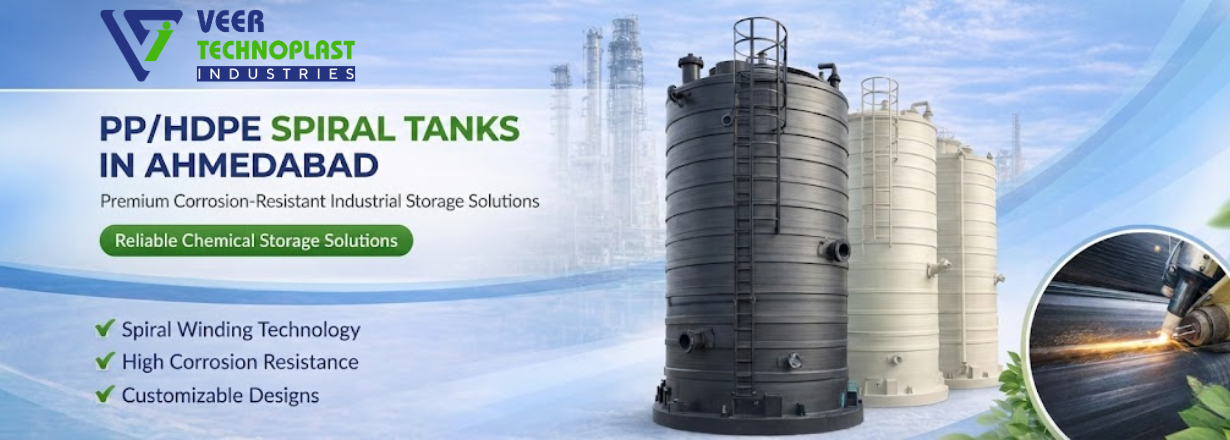
PP/HDPE Spiral Tanks in Ahmedabad | Premium Industrial Storage Solutions
PP/HDPE Spiral Tanks in Ahmedabad
PP/HDPE Spiral Tanks in Ahmedabad represent premium industrial storage solutions
manufactured using advanced spiral winding technology. These heavy-duty tanks are engineered for storing highly
corrosive chemicals, acids, alkalis, and process liquids in demanding industrial environments across chemical
processing, water treatment, electroplating, pharmaceuticals, and manufacturing facilities.
Built with Polypropylene or High-Density Polyethylene materials and designed through
seamless spiral construction, these tanks deliver exceptional strength, corrosion resistance, and long
operational life. Customizable in diameter, height, wall thickness, and configuration, PP/HDPE Spiral Tanks
provide reliable, maintenance-free, and cost-effective storage for critical industrial applications throughout
Ahmedabad and Gujarat.
Understanding Spiral Tank Technology
Spiral winding technology revolutionizes industrial tank manufacturing by creating
seamless, stress-free storage vessels through continuous spiral extrusion and precision welding processes.
Unlike traditional fabrication methods that rely on multiple panels joined together, spiral tank construction
winds thermoplastic material in a continuous helix pattern, eliminating vertical seams and weak points that
commonly lead to leaks and failures in conventional tanks.
This advanced manufacturing approach produces tanks with uniform wall thickness,
superior structural integrity, and enhanced resistance to impact, stress cracking, and chemical attack. The
spiral winding process allows for precise control over wall thickness and density, resulting in tanks that can
withstand higher pressures and more aggressive chemical environments than conventionally fabricated
alternatives.
PP/HDPE Spiral Tanks manufactured in Ahmedabad incorporate extrusion welding and
butt-fusion techniques that create molecular bonds stronger than the base material itself. This seamless
construction ensures complete leak-proof performance throughout the tank's service life, eliminating the
maintenance requirements and potential failure points associated with bolted or mechanically joined tank
systems.
Advanced Manufacturing Process
The manufacturing of PP/HDPE Spiral Tanks begins with careful material selection
based on the specific chemical resistance and temperature requirements of the intended application.
Polypropylene offers excellent resistance to acids and alkalis with temperature tolerance up to 90°C, while
High-Density Polyethylene provides superior impact resistance and flexibility for applications requiring robust
physical properties.
During spiral winding production, thermoplastic sheets are precision-heated to
optimal fusion temperature and continuously wound around a rotating mandrel in overlapping spiral patterns.
Multiple layers are simultaneously extruded and welded together through hot-gas or extrusion welding techniques,
creating homogeneous wall structures without joints or seams that could compromise tank integrity.
Computer-controlled winding systems ensure consistent spiral pitch, overlap width,
and welding temperature throughout the tank body, resulting in uniform wall thickness and structural properties
from top to bottom. This precision manufacturing process eliminates the human error and inconsistency common in
manual fabrication methods, producing tanks that meet strict quality standards and deliver predictable long-term
performance.
After primary winding completion, tanks undergo precision machining for nozzle
installations, manhole openings, and connection points. These openings are reinforced through additional
material layering and are welded using extrusion or electrofusion techniques that maintain the seamless
integrity of the spiral construction. Final inspection includes pressure testing, dimensional verification, and
visual examination to ensure each tank meets industrial standards before delivery to customers in Ahmedabad.
Material Properties and Chemical Resistance
Polypropylene spiral tanks exhibit outstanding resistance to strong acids including
sulfuric acid, hydrochloric acid, nitric acid, and phosphoric acid across a wide concentration range. PP
material maintains structural integrity when exposed to alkalis such as sodium hydroxide, potassium hydroxide,
and ammonia solutions, making it the preferred choice for chemical processing and metal finishing operations
throughout Ahmedabad's industrial sector.
High-Density Polyethylene spiral tanks offer superior performance with oxidizing
chemicals, chlorinated compounds, and process solutions requiring enhanced impact resistance. HDPE demonstrates
excellent resistance to alcohols, detergents, and mild acids while providing better low-temperature performance
than polypropylene, with functional operation down to -20°C for applications requiring cold storage or outdoor
installation during winter months.
Both PP and HDPE materials are completely inert to biological growth, preventing
algae formation, bacterial colonization, and biofilm development that commonly plague metal and concrete storage
systems. This inherent resistance to biological attack makes spiral tanks ideal for water treatment,
pharmaceutical processing, and food-grade applications where maintaining product purity and preventing
contamination are critical requirements.
UV stabilization additives incorporated during material extrusion protect spiral
tanks from photodegradation during outdoor installation in Ahmedabad's intense sunlight and high ambient
temperatures. These UV stabilizers prevent surface chalking, color fading, and mechanical property degradation
that would otherwise reduce tank lifespan, ensuring reliable performance for 20 years or more under direct solar
exposure.
Key Features and Benefits
Seamless spiral winding construction eliminates vertical seams and potential leak
points for superior long-term reliability
Exceptional resistance to corrosive chemicals, acids, alkalis, and industrial
effluents without degradation or material breakdown
Uniform wall thickness throughout tank height ensures consistent structural
properties and predictable stress distribution
Superior impact strength and crack resistance compared to conventionally
fabricated thermoplastic tanks
Lightweight construction reduces foundation requirements and installation costs
while maintaining structural strength
Complete rust-free and corrosion-free operation eliminates maintenance painting
and surface treatment requirements
UV-stabilized material formulation provides decades of reliable outdoor
performance in harsh climates
Fully customizable dimensions, wall thickness, and accessory configurations to
match specific application requirements
Lower installation and lifetime operating costs compared to metal, concrete, or
fiberglass reinforced plastic alternatives
Excellent thermal insulation properties reduce heat gain or loss for
temperature-sensitive storage applications
Non-conductive material eliminates electrolytic corrosion and stray current damage
in industrial environments
Smooth interior surfaces prevent sediment accumulation and facilitate complete
drainage and cleaning
Technical Specifications
Base Materials
Polypropylene copolymer or High-Density Polyethylene with virgin-grade resin
meeting industrial purity standards. Material selection based on chemical compatibility, temperature
requirements, and specific application demands throughout Ahmedabad facilities.
Manufacturing Method
Advanced spiral winding technology with continuous extrusion welding, butt-fusion
joining, and precision overlap control. Computer-controlled winding systems ensure consistent quality and
dimensional accuracy across all production sizes.
Capacity Range
500 liters to 50,000 liters standard production range with fully customizable
larger capacities available. Tank sizing optimized for space utilization and operational requirements in
industrial facilities across Ahmedabad and Gujarat.
Wall Thickness Options
8mm to 40mm wall thickness depending on tank diameter, storage capacity, and
internal pressure requirements. Structural calculations performed for each application to ensure adequate
safety factors and long-term durability under operating conditions.
Temperature Tolerance
HDPE spiral tanks operate from -20°C to +60°C continuous service temperature.
Polypropylene variants function from 0°C to +90°C with peak temperature resistance suitable for hot process
liquids and elevated ambient conditions.
Design Configurations
Vertical cylindrical, horizontal, flat bottom, conical bottom, and rectangular
designs available. Configuration selection based on installation space, drainage requirements, and process
integration needs for Ahmedabad industrial applications.
Standard Accessories
Manhole openings with gasketed covers, inlet and outlet nozzles, overflow
connections, drain valves, level indicators, ladder supports, flange connections, and venting provisions. All
accessories custom-positioned during manufacturing to match piping layouts and operational requirements.
Quality Standards
Manufactured following industrial chemical storage guidelines with quality control
procedures including pressure testing, dimensional inspection, weld examination, and material certification.
Each tank documented with manufacturing records and material traceability.
Industrial Applications
Chemical Processing and Storage
PP/HDPE Spiral Tanks serve as primary storage vessels for concentrated acids,
caustic solutions, solvents, and reactive chemicals in pharmaceutical manufacturing, chemical synthesis, and
industrial processing facilities throughout Ahmedabad. The seamless construction and superior chemical
resistance ensure safe containment of aggressive substances without risk of leakage or material degradation
over extended service periods.
Effluent Treatment Operations
Spiral tanks function as equalization tanks, chemical dosing vessels,
neutralization reactors, and clarified water storage in effluent treatment plants and sewage treatment
facilities. The corrosion-resistant construction withstands continuous exposure to varying pH levels,
oxidizing agents, and biological activity without deterioration, ensuring reliable long-term operation in
wastewater processing applications.
Water Treatment Systems
Industrial water treatment plants utilize spiral tanks for chemical
preparation, coagulant storage, filter backwash collection, and treated water storage. The smooth interior
surfaces prevent sediment accumulation and facilitate cleaning, while the chemically inert material ensures no
contamination of processed water intended for industrial processes or potable consumption.
Electroplating and Metal Finishing
Spiral tanks provide corrosion-resistant storage for pickling acids, plating
solutions, rinse water, and chemical recovery systems in electroplating shops and metal finishing operations
across Ahmedabad's manufacturing sector. The tanks resist the highly aggressive chemical environments typical
of these applications while offering the structural strength needed for elevated operating temperatures.
Pharmaceutical Manufacturing
Pharmaceutical facilities employ spiral tanks for raw material storage,
intermediate processing, solvent recovery, and waste collection where material purity and contamination
prevention are paramount. The smooth, non-porous surfaces resist bacterial growth and facilitate sanitization,
meeting the stringent hygiene requirements of pharmaceutical production environments.
Textile and Dyeing Industries
Textile processing units use spiral tanks for dye preparation, chemical
mixing, hot water storage, and process liquid circulation. The temperature-resistant PP construction handles
hot dye baths and chemical solutions while the corrosion resistance ensures long service life despite
continuous exposure to aggressive textile processing chemicals.
Agricultural and Fertilizer Applications
Agriculture and fertilizer industries deploy spiral tanks for bulk storage of
liquid fertilizers, pesticides, herbicides, and irrigation chemicals. The UV-stabilized construction enables
outdoor installation while the chemical resistance handles corrosive fertilizer formulations without
degradation, providing reliable storage throughout growing seasons.
Food Processing Operations
Food-grade HDPE spiral tanks store process water, cleaning chemicals, brine
solutions, and food-safe liquids in food processing facilities. The FDA-compliant material formulation and
smooth, cleanable surfaces meet food safety standards while providing the durability and chemical resistance
needed for industrial food production environments.
Advantages Over Alternative Tank Systems
PP/HDPE Spiral Tanks deliver substantial advantages compared to traditional steel,
stainless steel, or concrete storage tanks commonly used in industrial applications. The inherent corrosion
resistance of thermoplastic materials eliminates the internal and external corrosion that progressively weakens
metal tanks, avoiding costly repairs, lining replacements, and premature tank failures that plague steel storage
systems throughout their service life.
Weight advantages become significant in larger tank installations where spiral tanks
weigh 70-80% less than equivalent steel or concrete structures. This reduced weight translates directly into
lower foundation costs, simplified installation procedures, and reduced structural requirements for elevated or
rooftop installations common in space-constrained industrial facilities across Ahmedabad.
Maintenance requirements for spiral tanks are minimal compared to metal alternatives
that require regular inspection, coating renewal, cathodic protection maintenance, and eventual replacement due
to corrosion damage. The maintenance-free nature of thermoplastic construction eliminates these recurring costs
while reducing downtime associated with tank inspection and repair activities.
Installation timelines are substantially shorter for spiral tanks compared to
field-erected steel or concrete tanks that require extensive on-site fabrication and curing time.
Factory-manufactured spiral tanks arrive ready for immediate installation, requiring only foundation preparation
and utility connections, enabling faster project completion and earlier production startup for new facilities or
capacity expansions.
Total cost of ownership calculations consistently favor spiral tanks when considering
initial purchase price, foundation expenses, installation labor, ongoing maintenance costs, and expected service
life. While the upfront cost may be comparable to basic steel tanks, the elimination of maintenance expenses and
extended operational life result in lower lifetime costs and superior return on investment for industrial
storage applications.
Industries Served in Ahmedabad
Veer Technoplast Industries manufactures and supplies PP/HDPE Spiral Tanks to diverse
industrial sectors operating throughout Ahmedabad and the broader Gujarat region. The customizable nature of
spiral tank technology enables optimal solutions for varied applications across multiple industries requiring
chemical-resistant storage capabilities.
Chemical Manufacturing
Pharmaceutical Production
Textile Processing
Electroplating Facilities
Water Treatment Plants
Effluent Treatment Systems
Metal Finishing Operations
Fertilizer Manufacturing
Food Processing Units
Mining and Mineral Processing
Paper and Pulp Industry
Automotive Component Manufacturing
Customization Capabilities
Every PP/HDPE Spiral Tank manufactured by Veer Technoplast Industries can be fully
customized to meet specific application requirements and site constraints. Tank diameter, height, and capacity
are engineered based on available installation space, required storage volume, and future expansion
considerations, ensuring optimal utilization of facility resources while accommodating operational needs.
Wall thickness customization provides appropriate structural strength for internal
pressures, external loads, and safety factors required by the application. Thicker walls accommodate higher
pressures, elevated temperatures, or aggressive chemical services, while optimized wall thickness for standard
applications reduces material costs without compromising performance or longevity.
Nozzle locations, sizes, and orientations are positioned during manufacturing to
align with existing piping layouts and process requirements. Multiple inlet connections, outlet drains, overflow
pipes, sampling ports, and instrumentation connections can be incorporated at specified elevations and
orientations, eliminating field modifications and ensuring proper process integration.
Bottom configurations include flat bottom designs for concrete pad installation,
conical bottoms for complete drainage and sediment removal, or dished bottoms for specific process requirements.
Top configurations accommodate open tanks for atmospheric storage, covered tanks with vented manholes, or fully
sealed tanks for volatile chemicals or pressurized applications requiring vapor containment.
Additional customization options include internal baffles for mixing applications,
heating or cooling coils for temperature control, level monitoring systems, overflow protection devices, and
specialized linings or coatings for extreme service conditions. Each customization is engineered and integrated
during manufacturing rather than added as aftermarket modifications, ensuring structural integrity and optimal
performance.
Maintenance and Service Life
PP/HDPE Spiral Tanks require minimal maintenance throughout their operational life
due to the inherent properties of thermoplastic construction. Unlike metal tanks that demand regular inspection
for corrosion, coating condition assessment, and preventive maintenance to extend service life, spiral tanks
operate maintenance-free for decades without degradation or performance loss.
Routine maintenance consists primarily of periodic visual inspection to verify proper
operation of valves, level indicators, and ancillary equipment rather than tank structure evaluation. Internal
cleaning following normal industrial practices maintains process efficiency but does not impact tank integrity
or require specialized procedures beyond those needed for the stored materials themselves.
The smooth interior surfaces of spiral tanks resist scaling, fouling, and sediment
accumulation that plague rough-surfaced metal or concrete tanks. This characteristic reduces cleaning frequency
and simplifies cleaning procedures when required, minimizing downtime and reducing operational costs associated
with tank maintenance throughout the facility operating life.
Expected service life for properly specified and installed PP/HDPE Spiral Tanks
exceeds 25 years under normal industrial operating conditions. Many installations continue functioning reliably
beyond this timeframe with no indication of material degradation or structural deterioration, providing
long-term value and eliminating the capital expense of premature tank replacement common with less durable
storage systems.
Installation Considerations
Proper installation begins with adequate foundation preparation to ensure level,
stable support for the filled tank weight. Concrete pads for vertical tanks should be level within specified
tolerances, properly cured, and sized to distribute the loaded tank weight across adequate soil bearing area.
Foundation design accounts for local soil conditions, groundwater levels, and seismic requirements applicable to
the Ahmedabad region.
Vertical spiral tanks are typically installed on concrete ring walls or full concrete
pads depending on tank size and configuration. The foundation surface must be smooth and free of sharp
projections that could create stress concentration points in the tank bottom. A sand bed or protective mat may
be specified between the foundation and tank to ensure uniform support and prevent point loading.
Horizontal spiral tanks require saddle supports or cradle mounting systems that
distribute the filled tank weight without creating stress concentrations or deformation. Support locations and
configurations are engineered during tank design to ensure proper weight distribution and prevent sagging or
distortion under filled conditions.
Piping connections to tank nozzles should include flexible connections or expansion
joints to accommodate thermal expansion differences between the thermoplastic tank and metal piping systems.
Rigid piping connections can impose stresses on tank nozzles during temperature changes, potentially causing
leaks or structural damage over time.
Adequate venting is essential for atmospheric tanks to prevent vacuum formation
during draining or pressure buildup during filling. Vent sizing follows standard engineering practices based on
maximum fill and drain rates, ensuring atmospheric pressure maintenance inside the tank during all operating
conditions.
Tank Selection Guidelines
Selecting the appropriate PP/HDPE Spiral Tank for specific applications requires
careful evaluation of stored material properties, operating conditions, and site requirements. Chemical
compatibility verification ensures the selected material resists degradation from the stored substance across the
expected concentration and temperature range. Chemical resistance charts provide guidance, but testing with actual
process fluids is recommended for critical applications or unusual chemical mixtures.
Temperature considerations influence material selection between PP and HDPE options.
Polypropylene offers higher temperature resistance suitable for hot process liquids up to 90°C, while HDPE
provides better low-temperature performance and impact resistance for cold storage or outdoor installations in
regions experiencing freezing temperatures.
Capacity determination considers current storage requirements plus anticipated future
growth to avoid premature capacity limitations. Installing adequate storage capacity initially proves more
cost-effective than adding supplementary tanks later, though modular installations of multiple smaller tanks may
offer operational flexibility advantages for some applications.
Design pressure requirements dictate necessary wall thickness and structural
reinforcement for applications involving pressurized storage, elevated temperatures creating vapor pressure, or
external loads from agitation equipment or internal structures. Engineering calculations determine appropriate
wall thickness to maintain adequate safety factors under all operating conditions including upset or emergency
scenarios.
Site access and installation logistics may constrain maximum tank size due to
transportation limitations, crane availability, or physical access restrictions at the installation location.
Larger tanks that cannot be transported intact may require segmented construction and field welding, though this
approach reduces the seamless advantage of factory-manufactured spiral tanks.
Quality Assurance and Testing
Each PP/HDPE Spiral Tank manufactured undergoes comprehensive quality control
procedures to verify compliance with engineering specifications and industrial standards. Material verification
testing confirms that virgin-grade PP or HDPE resin meets specified property requirements before production
begins, ensuring consistent material quality across all manufactured tanks.
In-process quality monitoring during spiral winding verifies proper weld temperature,
overlap width, and spiral pitch throughout tank construction. Computer-controlled winding systems maintain these
parameters automatically, while periodic operator verification ensures the automated systems function correctly
and produce consistent quality welds.
Visual inspection following production completion examines all surfaces, welds, and
nozzle connections for defects, irregularities, or incomplete fusion. Any identified issues are corrected through
additional welding or material application before the tank proceeds to pressure testing and final acceptance.
Hydrostatic pressure testing demonstrates tank integrity by filling with water and
pressurizing to specified test pressure, typically 1.5 times the maximum operating pressure. The tank is
maintained at test pressure for a specified duration while inspectors examine all surfaces for leaks, deformation,
or other evidence of structural inadequacy. Only tanks successfully passing pressure testing are approved for
shipment to customers.
Documentation provided with each tank includes material certifications, dimensional
inspection records, pressure test results, and manufacturer's statements of compliance. This documentation
supports customer quality assurance programs and provides traceability for regulatory compliance requirements in
pharmaceutical, food processing, and other regulated industries operating throughout Ahmedabad.
Frequently Asked Questions
What is the expected lifespan of PP/HDPE Spiral Tanks in Ahmedabad industrial conditions?
PP/HDPE Spiral Tanks typically deliver 25 to 30 years of reliable service life under normal industrial operating
conditions in Ahmedabad. The UV-stabilized thermoplastic construction resists degradation from sunlight exposure
and high ambient temperatures while the corrosion-resistant material properties ensure long-term integrity
despite continuous chemical exposure. Many installations continue functioning reliably beyond the expected
lifespan with no signs of structural deterioration or performance degradation.
How do PP and HDPE material options differ for spiral tank applications?
Polypropylene spiral tanks offer superior temperature resistance up to 90°C and excellent resistance to strong
acids and alkalis, making them ideal for chemical processing and hot liquid storage applications. HDPE spiral
tanks provide better impact resistance, superior low-temperature performance down to -20°C, and enhanced
resistance to oxidizing chemicals. Material selection depends on specific chemical compatibility requirements,
operating temperature range, and mechanical property needs for the intended application.
Can PP/HDPE Spiral Tanks be installed outdoors in Ahmedabad climate conditions?
Yes, PP/HDPE Spiral Tanks are specifically engineered for outdoor installation in harsh climate conditions
including Ahmedabad's intense sunlight and high ambient temperatures. UV-stabilization additives incorporated
during material extrusion protect against photodegradation and surface deterioration from prolonged sun
exposure. The tanks maintain structural integrity and chemical resistance throughout decades of outdoor service
without requiring protective covers or coatings.
What capacity range is available for PP/HDPE Spiral Tanks?
Standard production capacities for PP/HDPE Spiral Tanks range from 500 liters for small applications to 50,000
liters for large industrial storage requirements. Custom larger capacities exceeding 50,000 liters can be
manufactured based on specific project needs and site requirements. Tank dimensions including diameter, height,
and wall thickness are fully customizable to optimize storage capacity while accommodating available
installation space and structural requirements.
How does spiral winding technology differ from conventional tank fabrication methods?
Spiral winding creates seamless tanks through continuous helical winding of thermoplastic material with
simultaneous extrusion welding, eliminating the vertical seams and panel joints present in conventionally
fabricated tanks. This seamless construction produces superior structural integrity, eliminates weak points that
could lead to leaks, and creates uniform wall thickness throughout the tank height. Conventional fabrication
joins multiple panels through welding or mechanical fastening, creating potential failure points and stress
concentrations absent in spiral wound construction.
What maintenance is required for PP/HDPE Spiral Tanks during operation?
PP/HDPE Spiral Tanks require minimal maintenance throughout their operational life. Routine maintenance consists
of periodic visual inspection to verify proper operation of valves, level indicators, and ancillary equipment.
Internal cleaning follows normal industrial practices based on the stored material but does not require
specialized procedures or impact tank structural integrity. Unlike metal tanks, spiral tanks never require
coating renewal, corrosion inspection, or protective surface treatments, resulting in substantially lower
lifetime maintenance costs.
Are PP/HDPE Spiral Tanks suitable for food-grade applications?
Yes, HDPE Spiral Tanks manufactured from FDA-compliant food-grade resin are suitable for storing food processing
ingredients, potable water, and food-safe liquids. The smooth, non-porous interior surfaces resist bacterial
growth and facilitate thorough cleaning and sanitization. Material certifications document compliance with food
contact regulations, making these tanks appropriate for food processing facilities, beverage production, and
other applications requiring food-grade storage capabilities.
How are nozzles and connections integrated into spiral tank construction?
Nozzles, manholes, and connections are precision-machined into the spiral wound tank wall and reinforced through
additional material layering around the opening perimeter. Connections are welded using extrusion or
electrofusion techniques that create molecular bonds stronger than the base material, maintaining the seamless
integrity of the spiral construction. All openings are positioned during manufacturing according to customer
specifications, eliminating field modifications and ensuring proper alignment with piping systems and process
equipment.
What foundation requirements are needed for PP/HDPE Spiral Tank installation?
Vertical spiral tanks require level concrete pads or ring walls designed to distribute the filled tank weight
across adequate soil bearing area. The foundation surface must be smooth, properly cured, and level within
specified tolerances to ensure uniform tank support and prevent stress concentrations. Foundation design
considers local soil conditions, tank capacity, and seismic requirements applicable to the Ahmedabad region.
Horizontal tanks require engineered saddle supports that distribute weight without creating deformation or
stress concentration in the tank wall.
Can existing metal or concrete tanks be replaced with PP/HDPE Spiral Tanks?
Yes, PP/HDPE Spiral Tanks serve as excellent replacements for corroded metal tanks or deteriorating concrete
tanks in existing facilities throughout Ahmedabad. The lighter weight of spiral tanks often allows installation
on existing foundations without structural upgrades. Custom dimensions accommodate available installation space
while nozzle locations can be positioned to match existing piping configurations, minimizing modification
requirements. The corrosion-resistant construction eliminates the recurring corrosion problems that necessitated
replacement of the original metal or concrete tanks.