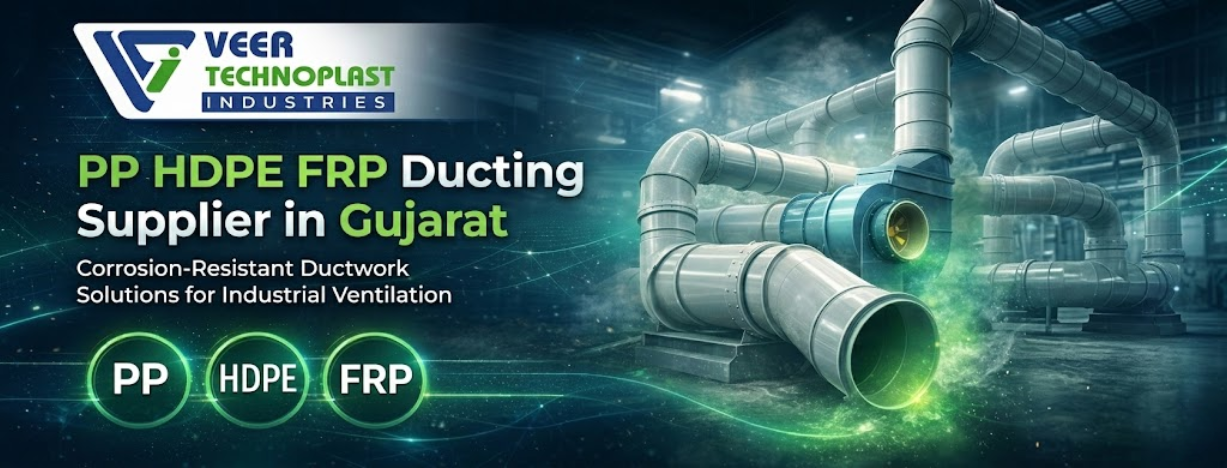
Industrial facilities that handle chemicals, fumes, vapors, and contaminated air require specialized ventilation systems designed to operate safely in corrosive environments. One of the most reliable solutions used in modern industrial ventilation infrastructure is corrosion-resistant thermoplastic and fiberglass ducting. A PP HDPE FRP ducting supplier in Gujarat provides engineered duct systems designed to safely transport contaminated air streams while maintaining structural integrity and long-term operational reliability.
Industrial Ventilation Systems
Industrial ventilation systems play a critical role in maintaining safe working environments by removing harmful gases, chemical vapors, dust particles, and process fumes. In facilities where conventional metal ducting may corrode quickly, polymer-based materials such as polypropylene (PP), high-density polyethylene (HDPE), and fiberglass reinforced plastic (FRP) provide superior durability and chemical resistance.
These ducting systems are widely used in chemical processing plants, electroplating units, pharmaceutical facilities, laboratories, wastewater treatment plants, and metal finishing industries. Their corrosion-resistant properties help prevent deterioration caused by acidic fumes, alkalis, solvents, and other aggressive chemical environments.
Understanding PP HDPE FRP Ducting Systems
PP, HDPE, and FRP ducting systems are engineered ventilation channels used to convey air, gases, vapors, and chemical fumes within industrial facilities. Unlike conventional metallic ducts, thermoplastic and FRP ducting materials offer excellent resistance to corrosion and chemical degradation.
Material Overview
Polypropylene ducting is widely used for handling acidic vapors and corrosive fumes due to its strong chemical resistance and low moisture absorption. HDPE ducting provides high impact strength and flexibility, making it suitable for installations that require mechanical durability. FRP ducting systems combine fiberglass reinforcement with chemical-resistant resins to deliver high structural strength along with improved temperature resistance.
Dual-laminate systems such as PP+FRP combine the advantages of thermoplastic and fiberglass materials. The inner thermoplastic layer provides chemical resistance, while the outer FRP layer enhances structural strength and rigidity.
These ducting systems are designed to maintain smooth airflow with minimal pressure loss, ensuring efficient extraction and transfer of contaminated air. Their lightweight construction also simplifies installation and reduces structural load on supporting infrastructure.
Industrial Demand for Corrosion-Resistant Ducting in Gujarat
Gujarat has developed into one of India's largest industrial manufacturing hubs. The state hosts extensive chemical manufacturing clusters, pharmaceutical production facilities, textile processing units, electroplating industries, and metal treatment plants. Many of these industries operate processes that generate corrosive fumes, acidic gases, and chemical vapors that must be safely removed from working environments.
Industrial facilities located in regions such as Ahmedabad, Vadodara, Ankleshwar, Bharuch, Vapi, and Surat rely heavily on corrosion-resistant ventilation infrastructure. Metal ducting systems often deteriorate rapidly in such environments due to continuous chemical exposure, leading to increased maintenance costs and operational risks.
This has created strong demand for PP, HDPE, and FRP ducting systems capable of withstanding aggressive industrial conditions for extended operational periods. A PP HDPE FRP ducting supplier in Gujarat provides customized ventilation solutions designed to match airflow requirements, chemical compatibility, and installation conditions within each facility.
Material Characteristics of PP HDPE FRP Ducting
Different ducting materials are selected depending on the type of chemical fumes, operating temperature, and airflow requirements within the industrial process.
Polypropylene ducting is widely used in chemical processing plants because it offers excellent resistance to acids, alkalis, and aggressive vapors. Its smooth internal surface helps reduce friction losses and supports efficient airflow movement.
HDPE ducting systems are valued for their strong mechanical durability and resistance to abrasion and impact. These systems are often used where ventilation pipelines may experience mechanical stress or environmental exposure.
FRP ducting systems provide high structural strength and can tolerate higher operating temperatures compared to thermoplastic materials. Fiberglass reinforcement adds rigidity and durability, making FRP suitable for large duct networks and high-volume airflow systems.
Dual laminate ducting such as PP+FRP combines chemical resistance with structural strength. The thermoplastic liner protects against chemical exposure, while the FRP shell provides mechanical support and stability.
Common Shapes and Configurations of Industrial Ducting
Industrial ventilation systems often require duct networks designed around complex plant layouts. PP HDPE FRP ducting systems are therefore manufactured in multiple shapes and configurations to accommodate different installation conditions.
Common ducting configurations include round ducts, rectangular ducts, square ducts, spiral ducts, and sectional ducting systems. The selection of duct shape depends on airflow capacity, available installation space, and pressure conditions within the ventilation system.
Industrial duct networks also include several accessories that support smooth airflow transitions and system flexibility. These components include elbows, bends, reducers, tees, dampers, flexible connectors, and structural support systems.
Proper duct layout design helps minimize turbulence, pressure drop, and airflow losses, ultimately improving the efficiency of industrial ventilation systems.
Applications of PP HDPE FRP Ducting in Industrial Ventilation
Industrial ventilation systems are essential for maintaining safe air quality within manufacturing facilities. Corrosion-resistant ducting systems play a vital role in transporting contaminated air safely from process areas to treatment equipment such as scrubbers or filtration units.
Chemical plant exhaust ventilation systems
Electroplating and metal finishing exhaust lines
Laboratory fume extraction systems
Pharmaceutical air handling systems
Wastewater treatment plant odor control ventilation
Fertilizer and agrochemical plant ventilation systems
Textile dye and pigment processing exhaust systems
Acid storage tank ventilation networks
These ducting systems help prevent the accumulation of toxic gases, support regulatory compliance, and improve workplace safety in industrial environments.
Role of Industrial Ducting in Fume Extraction Systems
Industrial processes often generate hazardous gases and chemical vapors that must be extracted before they accumulate in working areas. Effective fume extraction systems depend on well-designed duct networks to transport contaminated air from process equipment to treatment units.
PP HDPE FRP ducting systems are commonly integrated with industrial scrubbers, blowers, fume hoods, and air filtration systems. These ventilation networks capture harmful emissions directly at the source and convey them safely for neutralization or filtration.
Properly designed ducting systems ensure consistent airflow across the ventilation network while preventing leakage or contamination of surrounding workspaces.
Installation and Fabrication Considerations
The performance of an industrial ducting system depends not only on material selection but also on proper fabrication and installation practices. Ventilation systems must be designed to maintain stable airflow conditions while withstanding operational stresses.
Common joining methods used in thermoplastic and FRP ducting systems include:
Hot-air welding for thermoplastic duct joints
Extrusion welding for structural reinforcement
Flanged connections for modular installation
Adhesive bonding for FRP assemblies
Proper support structures, hangers, and clamps are required to maintain duct alignment and prevent vibration or mechanical strain. Accurate duct sizing and layout planning also help reduce pressure losses and improve energy efficiency within ventilation systems.
Advantages of PP HDPE FRP Ducting Systems
Industrial facilities prefer thermoplastic and FRP ducting systems because they offer several performance advantages compared to traditional metal ducting.
High resistance to corrosive chemicals and fumes
Lightweight construction that simplifies installation
Smooth internal surfaces that improve airflow efficiency
Long operational life with minimal maintenance requirements
Compatibility with industrial ventilation equipment
Flexible fabrication options for complex duct layouts
Maintenance and Long-Term Performance
Industrial ventilation systems must operate reliably over long periods to maintain workplace safety and regulatory compliance. PP HDPE FRP ducting systems require minimal maintenance compared to metal ducting because they do not rust or corrode under chemical exposure.
Routine inspections help verify duct integrity, airflow performance, and joint stability. Periodic cleaning may also be required in facilities where dust or particulate matter accumulates within duct networks.
Because thermoplastic and FRP materials resist chemical degradation, these ducting systems maintain structural performance and operational efficiency even in aggressive industrial environments.
Frequently Asked Questions
PP HDPE FRP ducting systems are used to transport contaminated air, chemical fumes, vapors, and gases within industrial ventilation networks. These systems help safely remove hazardous emissions from process areas and direct them to treatment systems such as scrubbers or filtration units.
Thermoplastic materials such as polypropylene and HDPE provide strong resistance against acids, alkalis, solvents, and chemical vapors. This resistance prevents corrosion and extends the operational life of ventilation systems used in chemical processing plants.
FRP ducting is reinforced with fiberglass, which provides higher mechanical strength and improved temperature resistance. Plastic ducting such as PP and HDPE mainly offers chemical resistance, while FRP adds structural durability for large or high-pressure ventilation systems.
Industrial ducting systems are typically custom-designed based on airflow capacity, chemical compatibility, installation space, and ventilation requirements. Manufacturers fabricate duct networks in different shapes, diameters, and configurations to match specific industrial processes.
Industries that commonly use corrosion-resistant ducting systems include chemical manufacturing, pharmaceuticals, electroplating, wastewater treatment, fertilizer production, textile processing, and laboratory facilities where hazardous fumes must be safely extracted.
Proper duct design ensures stable airflow, reduced pressure loss, and efficient removal of contaminated air. Well-planned duct networks improve ventilation efficiency while reducing energy consumption and operational risks within industrial facilities.