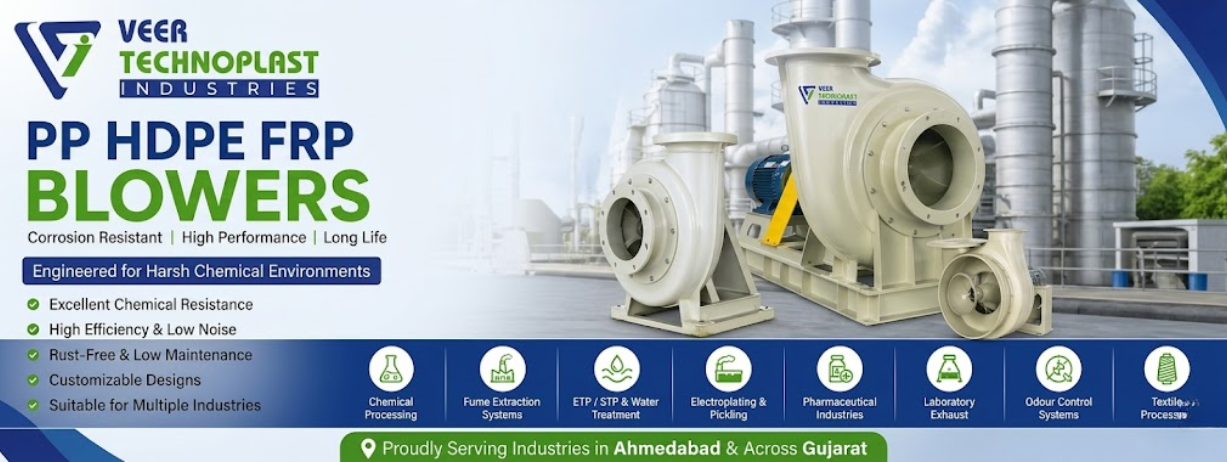
Industrial processes that involve chemical handling, fume generation, and corrosive environments require reliable airflow systems.
PP, HDPE, and FRP blowers have become essential in such industries due to their ability to perform consistently under aggressive conditions. In Ahmedabad, where sectors like chemical processing, electroplating, and water treatment are rapidly expanding, the demand for corrosion-resistant blower systems continues to increase.
These blowers are specifically engineered for environments where traditional metal blowers may fail due to rust, corrosion, or chemical exposure. By using advanced polymer-based materials, industries can achieve longer equipment life, reduced maintenance requirements, and stable performance over time.
Understanding PP, HDPE, and FRP Blowers
PP (Polypropylene), HDPE (High-Density Polyethylene), and FRP (Fiberglass Reinforced Plastic) are widely used materials in industrial blower manufacturing. Each material offers distinct advantages based on the application and level of chemical exposure.
PP and HDPE blowers are known for their lightweight structure and strong resistance to acids, alkalis, and chemical vapours. FRP blowers, on the other hand, provide higher mechanical strength along with excellent corrosion resistance, making them suitable for more demanding industrial environments.
In many applications, dual-laminate constructions such as PP+FRP are used to combine the benefits of both materials. This approach offers enhanced durability along with superior chemical compatibility.
Why Industries in Ahmedabad Prefer Non-Metallic Blowers
Ahmedabad is home to a wide range of industries, including chemicals, pharmaceuticals, textiles, and wastewater treatment facilities. These sectors frequently deal with corrosive fumes and hazardous gases, requiring specialized ventilation systems.
Traditional metal blowers tend to degrade quickly in such environments, leading to frequent breakdowns and increased operational costs. Non-metallic blowers made from PP, HDPE, and FRP help overcome these challenges by offering strong corrosion resistance and long-term reliability.
Additionally, industries in Gujarat are placing greater emphasis on environmental compliance and workplace safety. Efficient blower systems play a crucial role in controlling emissions, managing fumes, and maintaining safe operating conditions.
Key Features of PP HDPE FRP Blowers
Excellent resistance to corrosive fumes, acids, alkalis, and chemical vapours
Available in PP, HDPE, FRP, and dual-laminate constructions for application flexibility
High-efficiency impeller designs for consistent airflow performance
Lightweight construction for easier installation and handling
Low noise and vibration due to dynamically balanced impellers
Rust-free operation with reduced maintenance requirements
Customizable airflow capacity and pressure range
Suitable for multiple mounting configurations, including rooftop installations
Working Principle and Performance Efficiency
PP, HDPE, and FRP blowers operate on the principle of centrifugal airflow. Air or gas enters through the inlet and is accelerated by a rotating impeller. The kinetic energy is then converted into pressure energy, enabling the blower to move air efficiently through duct systems or treatment units.
The performance efficiency of these blowers depends on factors such as impeller design, airflow capacity, and system resistance. Backward-curved and forward-curved impellers are commonly used to achieve optimal efficiency while maintaining stable airflow.
Since these blowers are constructed using corrosion-resistant materials, they maintain consistent performance even in harsh operating conditions, minimizing downtime and performance loss.
Applications Across Industrial Sectors
PP, HDPE, and FRP blowers are widely used in industries that require efficient ventilation and fume extraction systems.
Fume extraction from chemical tanks and vessels
Airflow support in scrubber and gas treatment systems
Ventilation in ETP, STP, and water treatment plants
Exhaust systems in pickling and electroplating processes
Process air handling in chemical and pharmaceutical industries
Laboratory fume hood exhaust systems
Odour control systems in industrial plants
Ventilation in corrosive industrial environments
Role in Environmental Compliance and Safety
Industrial operations today are subject to strict environmental regulations, particularly related to emissions and air quality. PP, HDPE, and FRP blowers play an important role in meeting these requirements by effectively capturing and transporting harmful gases to treatment systems.
In scrubber systems, these blowers maintain the required airflow needed to neutralize toxic fumes before release into the atmosphere. This supports regulatory compliance while also improving workplace safety and environmental protection. In Ahmedabad and surrounding industrial zones, the adoption of such systems is increasing as companies focus on reducing environmental impact and ensuring safer operations.
Choosing the Right Blower for Industrial Needs
Selecting the appropriate blower depends on several operational and environmental factors.
Type of material based on chemical compatibility
Required airflow capacity and pressure range
Operating temperature conditions
Installation space and mounting requirements
Compatibility with existing ducting or scrubber systems
Careful selection ensures reliable performance, longer service life, and minimal operational issues.
Maintenance and Operational Considerations
One of the key advantages of PP, HDPE, and FRP blowers is their relatively low maintenance requirement. Since these materials do not corrode like metals, they reduce the need for frequent servicing.
However, routine inspection remains important for sustained efficiency. Monitoring impeller balance, checking alignment, and evaluating airflow performance can help prevent unexpected issues. Regular cleaning of ducts and ensuring proper airflow pathways also contribute to maintaining system efficiency over time.
Future Demand and Industry Growth in Gujarat
With ongoing industrial development in Gujarat, the demand for durable and efficient ventilation systems is expected to grow steadily. Industries are increasingly adopting advanced solutions that offer reliability, safety, and compliance with environmental standards.
PP, HDPE, and FRP blowers are well suited to meet these evolving requirements due to their adaptability and performance in challenging conditions. As industrial infrastructure continues to modernize, these blowers will remain an important part of ventilation and air handling systems.
FAQs
These blowers are used for fume extraction, ventilation, and air handling in industries where corrosive gases and chemical vapours are present. They help maintain safe working conditions and efficient airflow management.
Non-metallic blowers provide better resistance to corrosion, making them more durable in chemical environments. They also require less maintenance and offer a longer service life compared to metal blowers.
Yes, depending on the material and design, these blowers can operate at elevated temperatures, typically up to around 80–100°C.
Yes, they are commonly used in scrubber systems as they can handle corrosive gases while maintaining the consistent airflow required for gas treatment.
Industries such as chemical processing, pharmaceuticals, electroplating, wastewater treatment, and laboratories widely use PP, HDPE, and FRP blowers.
Selection depends on factors like chemical exposure, airflow requirements, pressure range, and installation conditions. Proper system evaluation helps in choosing the most suitable blower.
Conclusion
PP, HDPE, and FRP blowers have become a reliable solution for industries operating in corrosive environments with demanding ventilation needs. Their ability to deliver consistent performance, resist chemical damage, and operate efficiently makes them suitable for a wide range of industrial applications.
In Ahmedabad, where industrial activity continues to grow, these blowers play a crucial role in maintaining safety, ensuring environmental compliance, and supporting efficient process operations. Selecting the right blower system can significantly improve overall productivity and long-term operational stability.