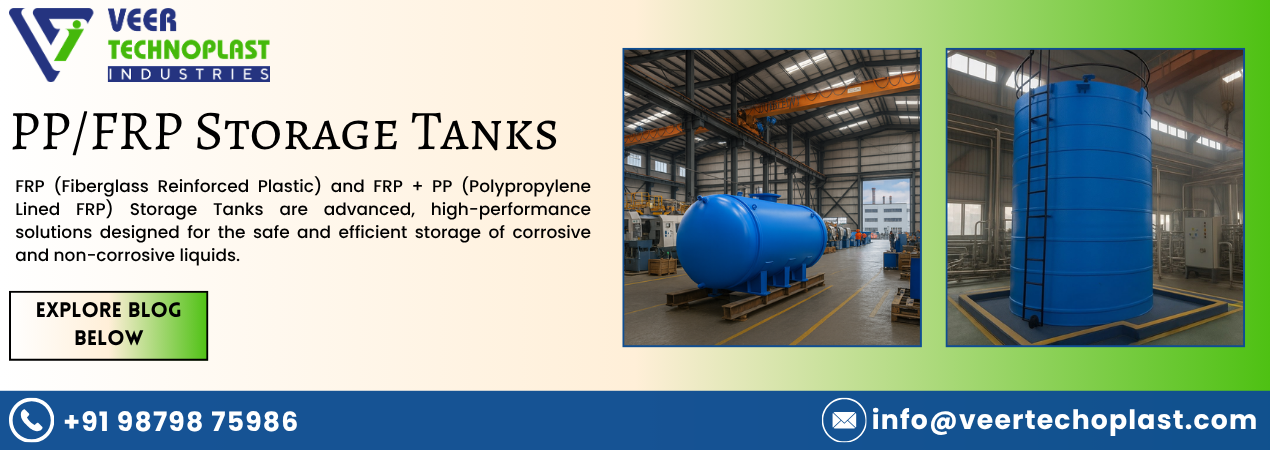
Industrial chemical storage requires materials that deliver durability, corrosion resistance, and long service life. PP/FRP Storage Tanks in Gujarat have become increasingly important across chemical processing, wastewater treatment, electroplating, pharmaceuticals, and related industries where secure liquid containment is essential.
Their combination of structural strength and chemical compatibility makes them suitable for handling aggressive media under demanding process conditions.
Gujarat has long been recognized as a major industrial hub with a strong presence in chemicals, pharmaceuticals, dyes, pigments, and process industries. This industrial ecosystem has created growing demand for advanced storage systems capable of safely and efficiently handling corrosive chemicals, acids, alkalis, solvents, and process liquids.
PP/FRP storage tanks are engineered to meet these requirements through a dual-material construction concept. The polypropylene lining offers chemical resistance, while the FRP outer structure provides mechanical strength, rigidity, and long-term durability. This combination supports reliable storage performance while helping reduce corrosion-related maintenance concerns.
A PP/FRP storage tank combines two materials designed to perform different functions within one integrated system.
Polypropylene serves as the internal wetted layer and remains in direct contact with stored chemicals. It is valued for resistance to a wide range of aggressive chemicals and process liquids. This inner layer supports chemical compatibility while helping reduce the risk of internal corrosion.
Fiberglass Reinforced Plastic forms the external structural shell. This layer contributes strength, rigidity, impact resistance, and support under industrial operating conditions. Depending on application requirements, tanks may be manufactured using hand lay-up or filament winding processes.
Industries often choose these tanks because they perform well in demanding operating environments while addressing corrosion and durability challenges associated with conventional storage systems. Their suitability is often linked to:
These characteristics make them practical for both storage and process applications across multiple industrial sectors.
The growing industrial demand in Gujarat has accelerated adoption of corrosion-resistant storage technologies. Chemical manufacturers require dependable tanks for acids and solvents. Pharmaceutical facilities prioritize contamination-resistant storage. Metal finishing industries require tanks compatible with pickling and plating chemicals.
As environmental regulations and process safety standards become increasingly stringent, industries are adopting engineered polymer composite tanks for compliance-oriented liquid storage applications.
This demand is particularly visible in industrial clusters involved in:
These sectors often require storage systems designed around both process compatibility and long-term operational reliability.
Several engineering characteristics contribute to the widespread use of these tanks in industrial environments.
The polypropylene liner provides resistance against many corrosive media, supporting safe containment of aggressive chemicals under process conditions.
The FRP shell adds rigidity and mechanical strength, helping tanks withstand demanding industrial service conditions.
Properly engineered manufacturing methods support seamless construction and secure storage with reduced leakage risk.
Outdoor installations benefit from weather-resistant properties that support long service life in exposed industrial environments.
Tanks can be manufactured in multiple dimensions, shapes, capacities, and configurations to meet plant-specific requirements.
These tanks are used across a wide range of industries because of their adaptability to different chemicals and process conditions.
They are widely used for storing acids, alkalis, solvents, and corrosive process chemicals where conventional materials may face corrosion-related limitations.
In ETP and STP systems, these tanks support storage and handling of treatment chemicals, neutralization solutions, and process liquids.
Metal treatment facilities often use these tanks in chemically aggressive applications associated with plating, pickling, and anodizing processes.
Their hygienic and corrosion-resistant properties make them suitable for many pharmaceutical liquid storage applications.
These tanks are commonly selected for storing process chemicals and liquid raw materials used in agrochemical operations.
Chemical-intensive processing sectors often rely on corrosion-resistant storage solutions for dyes, pigments, and auxiliary chemicals.

Selecting the right tank typically depends on process-specific requirements rather than storage volume alone. Important considerations generally include:
Proper evaluation of these factors supports long-term performance and application suitability.
One major advantage of PP/FRP storage tanks is customization. Industrial applications rarely have identical process requirements, so tanks are often manufactured according to specific operational needs.
Custom options may include:
Customization can also extend to liner thickness, reinforcement design, fittings, support structures, and accessory integration.
Compared with many conventional storage materials, polymer composite tanks offer several functional advantages in corrosive service. They often support:
These practical benefits contribute to their continued adoption across process industries.
Gujarat has developed strong manufacturing capabilities in polymer processing and corrosion-resistant equipment. This has contributed to regional expertise in customized tank fabrication for industrial applications.
Manufacturers serving this segment often support industries with engineered solutions tailored to process conditions, storage requirements, and compliance considerations. This regional strength has reinforced Gujarat's position in chemical process equipment and industrial storage systems.
Although these tanks are designed for durability, routine maintenance remains important. Good operational practices generally include periodic inspection of structural integrity, liner condition assessment, nozzle inspection, support checking, and process compatibility review during service changes.
Preventive maintenance supports safe operation and helps maximize service life.
As industrial processes become more specialized and chemical handling requirements continue evolving, storage systems must meet higher standards of reliability and material compatibility.
PP/FRP storage tanks remain relevant because they address several critical industrial requirements at once—corrosion resistance, structural strength, adaptability, and long-term performance. Their widespread use across Gujarat reflects their role as practical engineered storage solutions for demanding applications.
Veer Technoplast Industries manufactures durable, corrosion-resistant industrial tanks, scrubber systems, and advanced plastic engineering solutions.
2026 All Rights Reserved | Website by IndustryLead