
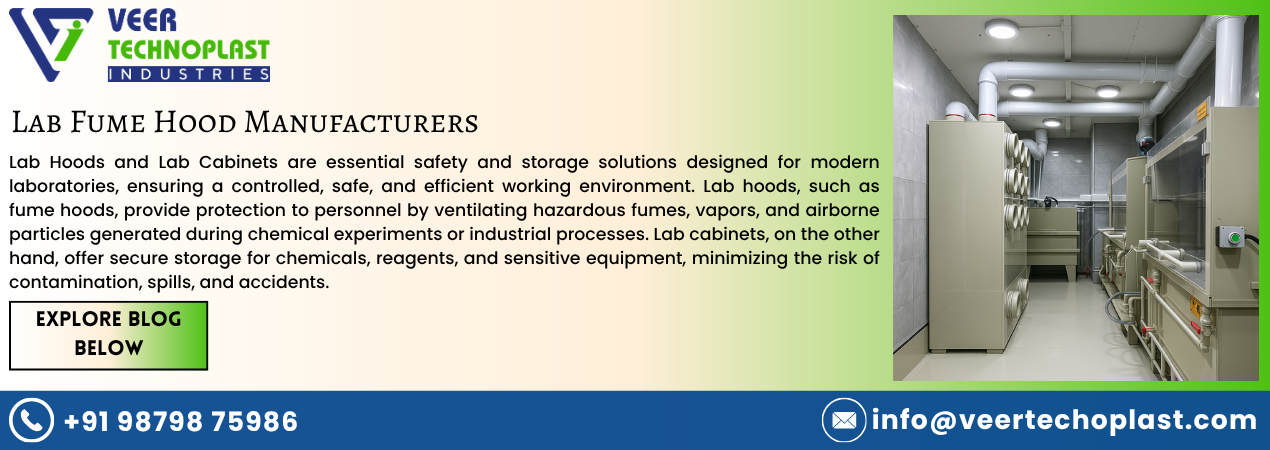
Lab Fume Hood Manufacturers
Lab Fume Hood Manufacturers
Laboratory work often involves chemicals, reagents, vapours, fumes, aerosols, and sensitive testing procedures. In such environments, safety and controlled ventilation are essential. A lab fume hood is designed to protect laboratory users by capturing and removing hazardous fumes before they spread into the working area. It also supports a cleaner and more organized laboratory setup where chemical handling can be performed with better confidence.
Veer Technoplast Industries
Veer Technoplast Industries manufactures lab fume hoods and lab cabinet solutions for laboratories that require chemical resistance, safety, durability, and functional design. These hoods are suitable for chemical labs, research facilities, pharmaceutical units, educational laboratories, quality control departments, and industrial testing areas where hazardous fumes or vapours may be generated during daily operations.
Understanding Lab Fume Hood Design
A lab fume hood is more than a simple enclosed workbench. It is a controlled ventilation system designed to capture, contain, and exhaust harmful fumes. The working chamber is built using chemical-resistant materials so it can withstand regular exposure to corrosive substances. The airflow system pulls contaminated air away from the user and directs it through a ducting or filtration arrangement.
Lab fume hoods may be ducted or ductless, depending on the application. Ducted systems are connected to external exhaust lines and are commonly used where stronger chemical fumes are produced. Ductless systems use suitable filters for specific applications and are selected based on chemical compatibility and safety requirements.
The construction material plays an important role in performance and service life. Materials such as PP, HDPE, FRP, stainless steel, and PP+FRP composites are commonly used because they resist corrosion and support long-term use in demanding laboratory conditions.
Why Lab Fume Hoods Are Important in Laboratories
Laboratories need a safe working environment because even small chemical reactions can release fumes, vapours, or airborne particles. Without proper ventilation, these contaminants may affect users, equipment, and surrounding work areas. A lab fume hood helps control these risks by keeping fumes inside the hood and removing them from the breathing zone.
It also improves workflow by providing a dedicated space for chemical handling, sample preparation, reagent mixing, titration, filtration, and analytical testing. When a fume hood is designed with proper airflow, lighting, work surface, and storage compatibility, it supports both safety and efficiency.
For industries where quality control and research work are performed regularly, lab fume hoods help maintain a controlled environment. They also reduce the chances of spills, contamination, odour spread, and accidental exposure during routine laboratory tasks.
Key Features of Lab Fume Hood
A well-designed lab fume hood includes practical safety and usability features that support day-to-day laboratory work.
- Chemical-resistant body made from PP, HDPE, FRP, stainless steel, or PP+FRP
- Efficient fume extraction system for hazardous vapours and fumes
- Smooth, non-reactive interior surface for easy cleaning
- Proper airflow design for containment and ventilation
- Integrated lighting for clear visibility during procedures
- Ducted or ductless configuration based on application needs
- Ergonomic working height for long-duration laboratory use
- Sash window or adjustable work opening for user protection
- Optional airflow display, alarm system, sinks, gas taps, and shelves
- Compatibility with PP, HDPE, and FRP ducting systems
These features make the fume hood suitable for laboratories where safety, durability, and chemical resistance are required together.
Materials Used in Lab Fume Hood Manufacturing
The material of construction must be selected according to the chemical nature of the laboratory process. PP and HDPE are widely used for corrosive chemical environments because they offer good resistance against acids and many industrial chemicals. FRP is preferred where strength and corrosion resistance are required together. Stainless steel is used in applications where hygiene, strength, and specific laboratory standards are important.
PP+FRP composite construction is also used for improved durability in harsh working conditions. The internal work surface may be made from PP, ceramic, epoxy, or stainless steel, depending on chemical exposure and cleaning requirements.
Selecting the correct material helps improve product life, reduce maintenance, and maintain safe working performance over time.
Applications of Lab Fume Hood
Lab fume hoods are used in different laboratory and industrial environments where fumes, vapours, or chemical exposure need to be controlled.
- Chemical and reagent handling
- Acid and solvent testing
- Toxic fume and vapour control
- Pharmaceutical laboratory work
- Biotechnology and life science applications
- Educational laboratory experiments
- Sample preparation and analytical testing
- QC and R&D laboratory processes
- Microbiology work with suitable filtration
- Ventilation for heat-generating laboratory equipment
Each application requires proper hood sizing, airflow planning, and material selection. This ensures that the fume hood performs safely according to the nature of the laboratory process.
Lab Fume Hood for Chemical Handling
Chemical handling is one of the most common uses of a lab fume hood. Many acids, solvents, and reagents release fumes that should not spread into the laboratory. A fume hood allows users to work inside a controlled chamber while the exhaust system removes contaminated air.
For chemical laboratories, the work surface should be non-reactive and easy to clean. The interior should withstand chemical spills and regular exposure to vapours. Proper airflow helps prevent fumes from escaping through the front opening, improving safety during experiments and testing activities.
Lab Fume Hood for Pharma and Research Laboratories
Pharmaceutical and research laboratories require safe, organized, and controlled working spaces. A lab fume hood supports sample preparation, chemical testing, formulation work, and analytical procedures. In such facilities, cleanliness, controlled ventilation, and material compatibility are important.
Lab fume hoods can also be customized with shelves, sinks, taps, lighting, sockets, and drainage systems based on process requirements. This makes them suitable for different departments such as R&D, quality control, testing, and laboratory production support.
How to Choose the Right Lab Fume Hood
Selecting the right lab fume hood depends on the type of chemicals used, the level of fumes generated, the working process, and the available ventilation setup. A general-purpose hood may not be suitable for every laboratory, especially where strong acids, high vapour loads, or special filtration needs are involved.
Before selecting a lab fume hood, buyers should consider:
- Type of chemicals and reagents used
- Required hood size and working area
- Ducted or ductless ventilation requirement
- Material compatibility with chemicals
- Airflow direction and face velocity needs
- Filter type, if filtration is required
- Need for sinks, gas taps, sockets, shelves, or storage
- Ease of cleaning and maintenance
- Laboratory safety requirements and working conditions
A properly selected fume hood improves safety, performance, and long-term usability.
Maintenance and Safety Considerations
Regular maintenance is important for keeping a lab fume hood safe and effective. The airflow should be checked periodically to ensure proper containment. Filters, ducting, exhaust systems, sash movement, lighting, and electrical components should be inspected as per usage conditions.
The work surface should be cleaned after use, especially when chemicals or reagents are handled. Users should avoid blocking airflow inside the hood with unnecessary equipment. The sash opening should be kept at the recommended level during operation to maintain proper face velocity.
Good usage practices, proper installation, and timely maintenance help improve safety and extend the working life of the fume hood.
Why Choose Veer Technoplast Industries
Veer Technoplast Industries offers lab fume hoods and lab cabinet solutions designed for laboratories that require chemical resistance, controlled airflow, and dependable construction. The company works with materials such as PP, HDPE, FRP, stainless steel, and PP+FRP composites to support different laboratory and industrial needs.
The products are designed for safety, practical usability, and long-term performance. With options for ducted systems, ductless configurations, filtration, lighting, work surfaces, storage cabinets, and process-based customization, Veer Technoplast Industries supports laboratories looking for functional and durable fume hood systems.
FAQs
Frequently Asked Questions
Quick Links
Get In Touch
Plot No :- 83, Jyot Industrial Park, Bakrol-dhamatwan Road, Bakrol Bujrang, Ahmedabad, Gujarat -382430
info@veertechnoplast.com
+91 98798 75986
+91 70430 43070
VEER TECHNOPLAST INDUSTRIES | All Rights Reserved.