
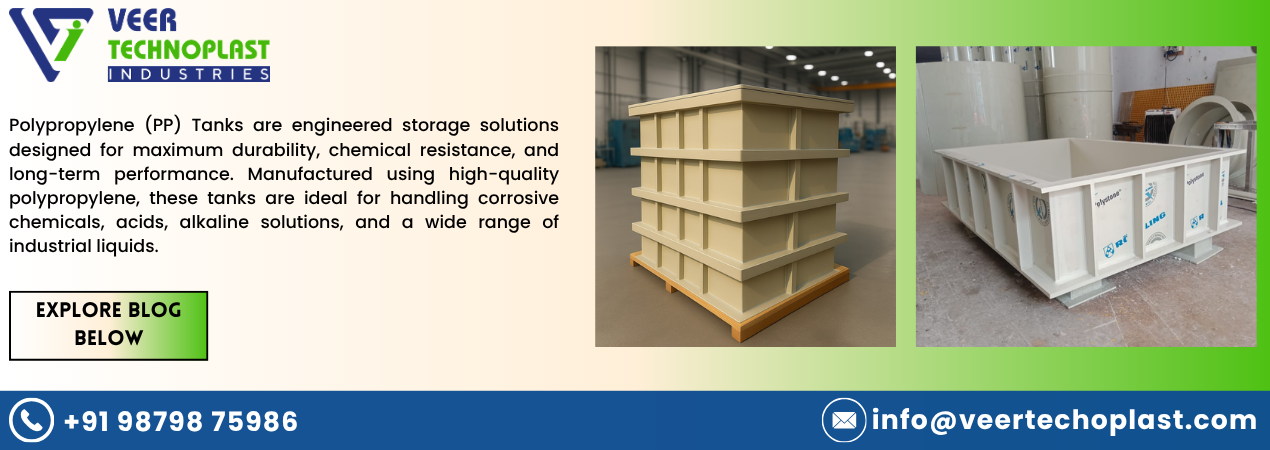
Industrial PP Tank Manufacturer
Industrial PP Tank Manufacturer
An Industrial PP Tank Manufacturer plays an important role in supporting industries that need safe, durable, and corrosion-resistant liquid storage solutions.
Industrial PP Tank Manufacturer
Polypropylene tanks are widely used for storing chemicals, acids, alkaline solutions, process liquids, wastewater treatment chemicals, and other industrial fluids where metal tanks may not be suitable because of corrosion or chemical reaction risks.
PP tanks are preferred because polypropylene offers excellent resistance to many aggressive chemicals. This makes the material useful for chemical processing units, pharmaceutical plants, electroplating industries, textile and dye processing units, water treatment systems, food-processing applications, and many other process-based industries.
Veer Technoplast Industries manufactures PP tanks and related industrial plastic fabrication products for different storage and process applications. The purpose of an industrial PP tank is not only to hold liquid but also to support material compatibility, leak-proof construction, operational safety, and ease of maintenance. For industries where chemical resistance and durability are essential, choosing the right PP tank manufacturer becomes an important decision.
What Is an Industrial PP Tank?
An industrial PP tank is a storage or process tank manufactured using high-quality polypropylene material. It is designed to store or handle corrosive chemicals, acids, alkalis, solvents, process liquids, and other industrial fluids. Compared to many conventional storage materials, polypropylene is lightweight, non-corrosive, and suitable for applications where chemical resistance is required.
These tanks can be manufactured in different shapes, capacities, and thicknesses depending on the application. Common options include vertical cylindrical tanks, horizontal tanks, rectangular tanks, spiral tanks, sheet-fabricated tanks, and custom-designed tanks. The selection depends on liquid type, storage capacity, installation space, operating conditions, temperature range, and process requirements.
Industrial PP tanks are also used as reaction tanks, mixing tanks, neutralization tanks, buffer tanks, dosing tanks, and chemical holding tanks. Their smooth internal surface helps reduce contamination risk and makes cleaning easier. This is especially useful in industries where liquid purity, process hygiene, and simple maintenance are important.
Why Polypropylene Is Used for Industrial Tanks
Polypropylene is widely used in industrial tank manufacturing because it offers a practical balance of strength, chemical resistance, and long service life. In many industries, storage tanks are exposed to corrosive chemicals, fumes, moisture, and changing process conditions. PP material helps protect the tank structure from rust and corrosion, making it suitable for demanding environments.
Unlike metal tanks, PP tanks do not rust when exposed to water, chemicals, or humid surroundings. This makes them useful for chemical storage, effluent treatment, electroplating, pickling-related processes, and many liquid-handling applications. The material is also lightweight compared to many traditional tank materials, which can make installation, shifting, and maintenance easier.
Another important advantage of PP tanks is their fabrication flexibility. Tanks can be customized in terms of size, shape, wall thickness, nozzle placement, manhole design, support structure, drain arrangement, and fittings. This helps industries get a tank that matches their actual process requirement instead of depending only on a fixed-size standard option.
Key Features of Industrial PP Tanks
Industrial PP tanks are designed to handle challenging storage and process conditions. Their features depend on tank design, material grade, capacity, fabrication method, and application type.
- Rust-free and corrosion-resistant tank body
- Suitable for acids, alkalis, solvents, and corrosive liquids
- Leak-proof construction using reliable welding methods
- Lightweight structure with good mechanical strength
- Smooth internal surface for easier cleaning
- Customizable capacity, shape, thickness, and fittings
- Suitable for indoor and outdoor industrial use
- Optional reinforcement for selected heavy-duty applications
- Low maintenance requirement in normal operating conditions
- Long service life when used with compatible chemicals
These features make PP tanks suitable for industries where safety, chemical compatibility, and storage reliability are key priorities.
Industrial Applications of PP Tanks
Industrial PP tanks are used across many sectors because they support different chemical and liquid-handling requirements. Their use depends on liquid properties, temperature, storage duration, and process conditions.
How Industrial PP Tanks Are Manufactured
The manufacturing of industrial PP tanks requires careful material selection, proper design, accurate fabrication, and strong welding practices. The process generally starts with understanding the application, chemical type, required capacity, operating temperature, installation space, and fitting requirements. Based on these details, the tank design and material thickness are selected.
PP sheets or spiral-wound polypropylene material may be used depending on tank type and capacity. Fabricated tanks are shaped and joined through suitable welding processes such as extrusion welding or fusion welding. Proper welding is important because weak joints can lead to leakage, reduced strength, and operational issues.
Nozzles, flanges, drain points, manholes, level indicators, support structures, and reinforcement options are added as per the application requirement. For some heavy-duty conditions, external reinforcement or PP/FRP lining may be used to improve structural strength. After fabrication, tanks are checked for finish quality, welding strength, dimensional accuracy, and leak-proof performance.
Important Specifications to Consider
When selecting an industrial PP tank, the technical specifications should match the actual application. Choosing a tank only by capacity may not be enough because chemical nature, temperature, storage duration, and installation conditions also affect performance.
Common specification points include material grade, tank capacity, shape, wall thickness, welding method, reinforcement requirement, fitting details, operating temperature range, chemical compatibility, and installation type. For industrial use, the tank may need a customized design based on the liquid being stored and the process environment.
A typical PP tank may be manufactured in capacities ranging from small process tanks to large storage tanks. Shapes may include vertical cylindrical, horizontal, rectangular, or custom layouts. Wall thickness may vary depending on capacity and liquid load. For outdoor applications, UV-stabilized PP material may be preferred to improve durability under environmental exposure.
Benefits of Choosing the Right Industrial PP Tank Manufacturer
The quality of a PP tank depends heavily on the manufacturer's understanding of material behavior, chemical compatibility, fabrication accuracy, and industrial application needs. A reliable manufacturer helps industries get tanks that are not only durable but also suitable for the specific liquid and process requirement.
A properly manufactured PP tank supports safer storage, easier maintenance, reduced corrosion-related issues, and better long-term usability. It also helps reduce the risk of leakage, contamination, and frequent replacement when used correctly. Customization is another major benefit because different industries have different requirements for size, shape, fittings, and process connections. The right industrial PP tank manufacturer also helps in selecting suitable tank construction based on working conditions. This is important because a tank used for chemical storage may have different requirements from a tank used for mixing, neutralization, dosing, or water treatment.
Buyer Checklist for Industrial PP Tanks
Before selecting a PP tank, industries should review important technical and usage-related factors. This helps ensure the tank performs well under actual working conditions.
- Identify the exact chemical or liquid to be stored
- Check chemical compatibility with polypropylene
- Confirm required tank capacity and working volume
- Select suitable shape based on available space
- Review wall thickness according to liquid load
- Decide nozzle, drain, manhole, and fitting positions
- Consider indoor or outdoor installation conditions
- Check temperature range and process environment
- Ask for suitable reinforcement if required
- Ensure proper welding and leak-proof construction
This checklist helps buyers choose a tank that fits their process needs instead of selecting a general-purpose tank without proper evaluation.
Maintenance and Safe Use of Industrial PP Tanks
Industrial PP tanks require low maintenance compared to many traditional storage tanks, but proper usage and inspection are still important. Regular cleaning, checking for external damage, inspecting joints, and monitoring fittings can help maintain long-term performance. The tank should always be used with chemicals that are compatible with polypropylene.
Overloading, using unsuitable chemicals, exposing the tank to temperatures beyond the recommended range, or installing the tank without proper support can reduce its service life. For safe use, the tank should be placed on a stable foundation and connected with suitable piping and fittings. Periodic inspection helps identify early signs of wear, stress, or leakage.
For process industries, maintenance practices should be based on the type of liquid stored, frequency of use, cleaning requirement, and operating environment. A clean and properly maintained PP tank supports better process safety and reduces the possibility of contamination or operational interruption.
Why Industrial PP Tanks Are Preferred in Process Industries
Process industries often deal with liquids that can damage ordinary storage materials. Chemicals, acids, alkalis, and solvents require tanks that can withstand corrosion and remain stable during use. Industrial PP tanks are preferred because they offer a practical solution for such conditions while remaining lightweight and easy to maintain.
Their design flexibility also makes them suitable for different plant layouts. Whether the requirement is storage, dosing, treatment, neutralization, or mixing, PP tanks can be made according to the required capacity and process connections. This makes them useful for both small-scale and large-scale industrial operations.
In many industries, storage reliability directly affects production flow, safety, and maintenance planning. A well-manufactured PP tank helps support these needs by providing chemical resistance, leak-proof construction, and long-term service when used under suitable conditions.
Frequently Asked Questions
Conclusion
An Industrial PP Tank Manufacturer provides essential storage and process solutions for industries that handle corrosive liquids, chemicals, acids, alkalis, and other industrial fluids. PP tanks are valued for their corrosion resistance, leak-proof construction, lightweight structure, customization flexibility, and long-term usability.
For industries where safety, chemical compatibility, and durability are important, selecting the right PP tank is a practical investment in smoother operations and better liquid-handling performance. A properly designed and manufactured PP tank supports efficient storage, easier maintenance, and reliable use across different industrial applications.
Quick Links
Get In Touch
Plot No :- 83, Jyot Industrial Park, Bakrol-dhamatwan Road, Bakrol Bujrang, Ahmedabad, Gujarat -382430
info@veertechnoplast.com
+91 98798 75986
+91 70430 43070
VEER TECHNOPLAST INDUSTRIES | All Rights Reserved.