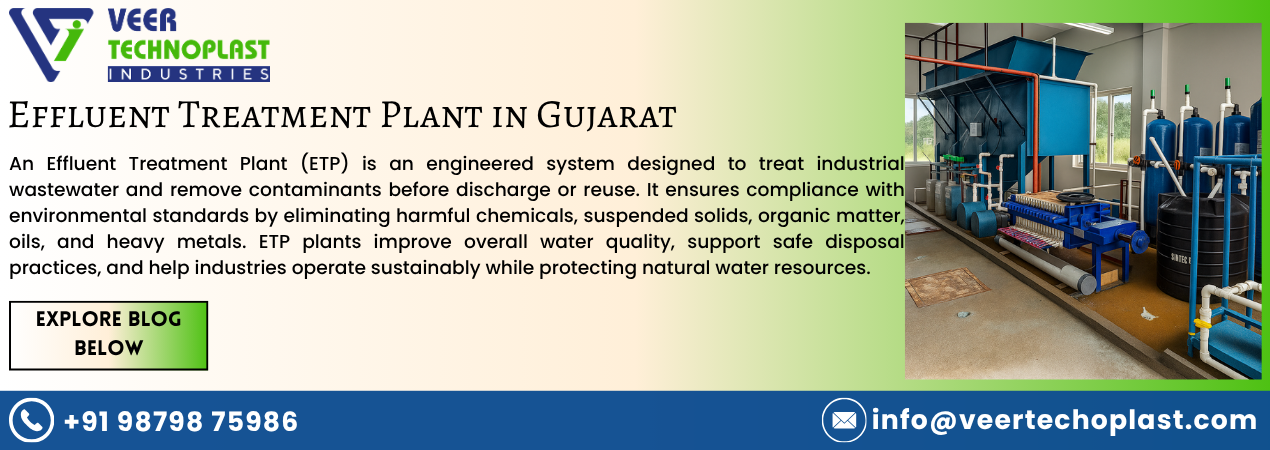
Effluent Treatment Plant in Gujarat | Veer Technoplast Industries
Industrial ETP Solutions
Effluent Treatment Plant in Gujarat
Industrial wastewater management has become a major
responsibility for manufacturing units, processing plants, chemical industries, textile units, metal finishing
facilities, and many other industrial sectors. In Gujarat, where industrial development is strong across
Ahmedabad, Vadodara, Surat, Rajkot, Bharuch, Vapi, Ankleshwar, and nearby regions, the demand for a reliable
Effluent Treatment Plant in Gujarat is increasing steadily.
Overview
ETP Plant & Veer Technoplast Industries
An Effluent Treatment Plant, commonly known as an ETP plant, is
designed to treat industrial wastewater before it is discharged, reused, or sent for further processing.
Industrial effluent may contain suspended solids, chemicals, oils, organic matter, heavy metals, acidic or
alkaline waste, and other harmful contaminants. If this wastewater is released without proper treatment, it can
affect water bodies, soil quality, public health, and the surrounding environment.
Veer Technoplast Industries is based in Ahmedabad, Gujarat, and
works in industrial plastic fabrication and process equipment solutions. The company provides products such as
PP tanks, HDPE tanks, PP/FRP storage tanks, PVC/PVDF tanks, spiral tanks, industrial blowers, ducting systems,
scrubber systems, pickling plants, plating tanks, refinery plants, and ETP plant solutions. These products are
used in industries that require corrosion-resistant, durable, and process-specific equipment for chemical
handling, wastewater treatment, fume control, and industrial applications.
Definition
What Is an Effluent Treatment Plant?
An Effluent Treatment Plant is an engineered wastewater treatment
system used to remove harmful impurities from industrial wastewater. The purpose of an ETP plant is to make
wastewater suitable for safe discharge, reuse, or further treatment as per applicable environmental standards.
The treatment process depends on the type of industry, wastewater characteristics, contamination level, chemical
load, and required output quality.
Unlike domestic wastewater, industrial wastewater can vary
greatly from one industry to another. Textile wastewater may contain dyes, color, salts, and suspended solids.
Chemical industry wastewater may include acidic, alkaline, toxic, or reactive substances. Electroplating and
metal finishing units may generate wastewater containing heavy metals. Food and beverage industries usually
produce organic-rich wastewater. Because of these variations, an ETP plant must be designed according to actual
wastewater conditions.
A properly designed ETP plant in Gujarat helps industries manage
wastewater responsibly while supporting compliance with pollution control norms. It also helps reduce
environmental risk, improve water quality, control sludge generation, and support sustainable industrial
operation.
Industry Need
Why Industries in Gujarat Need ETP Plants
Gujarat is one of India's major industrial states, with strong
activity in chemicals, pharmaceuticals, textiles, engineering, metal finishing, food processing, petrochemicals,
plastics, dyes, intermediates, packaging, and manufacturing. Many of these industries use water in production,
washing, cooling, cleaning, chemical processing, plating, or material handling. After use, the water carries
impurities that must be treated before disposal.
An Effluent Treatment Plant in Gujarat is important because
industries need to manage wastewater as per local and national environmental requirements. Untreated discharge
can create operational, legal, and environmental problems. Industries also require ETP systems to maintain
responsible operations, reduce pollution load, and support cleaner production practices.
In industrial zones around Ahmedabad, Vatva, Naroda, Odhav,
Sanand, Changodar, Ankleshwar, Vapi, Bharuch, Surat, and Vadodara, wastewater characteristics can be complex.
This makes proper treatment system selection essential. A standard or poorly matched system may not deliver the
required treatment results. The ETP plant must be selected based on wastewater volume, pH level, COD, BOD, TSS,
TDS, oil content, chemical nature, and process requirements.
Process
Main Working Process of an ETP Plant
An ETP plant usually works through a combination of physical,
chemical, and biological treatment stages. Each stage removes a specific type of impurity from wastewater. The
final treatment design may change depending on the industry and effluent type.
The common process stages include:
Screening to remove large particles, plastics, fibers, and floating matter from wastewater.
Equalization to balance flow rate and wastewater characteristics before treatment.
pH correction to neutralize acidic or alkaline wastewater.
Coagulation and flocculation to combine fine suspended particles into larger settleable particles.
Primary clarification to remove settled solids and reduce suspended load.
Biological treatment to reduce organic matter through aeration and microbial activity.
Secondary clarification to separate biological sludge from treated water.
Filtration to remove remaining fine particles and improve water clarity.
Disinfection or final polishing depending on discharge or reuse requirements.
Sludge handling through drying beds, filter press, or mechanical dewatering systems.
This multi-stage treatment approach helps industries achieve more
consistent output quality and safer wastewater management.
Features
Key Features of Effluent Treatment Plant
A well-designed ETP plant must be strong, efficient, practical,
and suitable for the wastewater conditions of the industry. Since industrial effluent can be corrosive, toxic,
acidic, alkaline, oily, or chemically loaded, the plant must be built with suitable materials and proper process
engineering.
Important features include:
Multi-stage treatment system for physical, chemical, and biological impurities.
Corrosion-resistant construction using PP, HDPE, FRP, MS, RCC, or suitable material.
Efficient aeration, settling, filtration, and sludge handling arrangement.
Chemical dosing system for pH control, coagulation, flocculation, and neutralization.
Proper flow management for stable treatment performance.
Modular plant layout for easy installation, operation, and future expansion.
Pumps and blowers selected according to wastewater flow and process demand.
Automation options for monitoring pH, flow rate, chemical dosing, and sludge level.
Designed to support compliance with pollution control norms.
Low-maintenance structure suitable for continuous industrial use.
Materials
Construction Materials Used in ETP Plants
The construction material of an ETP plant is selected according
to wastewater chemistry, temperature, process load, installation area, and long-term durability requirements. In
many industrial applications, corrosion resistance is a key factor because wastewater may contain acidic,
alkaline, or chemical contaminants.
PP and HDPE are commonly used where chemical resistance and
lightweight construction are required. FRP is suitable for corrosion-resistant tanks and process vessels. MS or
RCC may be used for larger civil-based treatment systems depending on site conditions and project design. In
chemical and plating industries, material selection becomes even more important because the plant comes in
contact with aggressive effluent.
Veer Technoplast Industries works with industrial products such
as PP tanks, HDPE tanks, PP/FRP storage tanks, PVC/PVDF tanks, ducting systems, blowers, scrubbers, and related
process equipment. This background supports the need for corrosion-resistant and application-specific design in
wastewater treatment and chemical handling applications.
Applications
Applications of ETP Plant in Gujarat
An Effluent Treatment Plant is used across many industrial
sectors where wastewater is generated during production, cleaning, washing, processing, or chemical handling.
The application depends on wastewater type and treatment requirement.
Common applications include:
Industrial wastewater treatment for safe discharge and process control.
Textile and dyeing units for removing color, chemicals, and suspended solids.
Pharmaceutical industries for treating process wastewater and chemical residues.
Chemical factories for neutralizing acidic, alkaline, or contaminated liquid waste.
Food and beverage units for treating organic-rich wastewater.
Electroplating and metal finishing units for removing heavy metals and toxic residues.
Oil and petrochemical plants for handling oily wastewater and hydrocarbon contamination.
Engineering and automotive units for treating coolant, wash water, and process effluent.
Manufacturing plants for reducing wastewater pollution load.
Industrial facilities planning treated water reuse for gardening, flushing, or utilities.
Because each industry has different wastewater characteristics,
the ETP design must be customized according to actual effluent analysis.
Benefits
Benefits of Installing an ETP Plant
Installing an Effluent Treatment Plant provides practical,
environmental, and operational benefits for industries. It is not only a compliance requirement but also a
responsible step toward sustainable industrial operation.
Key benefits include:
Helps remove harmful contaminants from industrial wastewater.
Supports compliance with environmental discharge standards.
Reduces pollution load before wastewater leaves the industrial premises.
Helps protect groundwater, soil, rivers, and surrounding natural resources.
Improves workplace responsibility and environmental management.
Allows treated water reuse in selected non-process applications where suitable.
Reduces dependency on unsafe disposal practices.
Helps industries manage sludge and wastewater more systematically.
For industries in Gujarat, these benefits are especially
important because many plants operate in dense industrial zones where environmental responsibility and
wastewater control are necessary.
Selection Guide
Important Factors Before Selecting an ETP Plant
Choosing the right ETP plant requires proper technical
evaluation. A plant should not be selected only by size or general design. Wastewater quality, flow rate,
industry type, treatment goal, and regulatory requirements must be considered carefully.
A practical buyer checklist includes:
Daily wastewater generation capacity.
Type of industry and process involved.
pH value, COD, BOD, TSS, TDS, oil, grease, and heavy metal content.
Required discharge standard or reuse requirement.
Space available for plant installation.
Type of construction material required.
Chemical dosing and automation needs.
Sludge generation and disposal method.
Power consumption and operational simplicity.
Scope for future expansion.
A properly planned ETP plant gives better treatment performance,
easier operation, and more reliable compliance support.
Specialized Industries
ETP Plant for Chemical, Textile, and Metal Industries
Chemical, textile, and metal processing industries often require
more careful wastewater treatment because their effluent may contain high contamination loads. Chemical units
may generate acidic, alkaline, or reactive wastewater. Textile units may generate colored wastewater with
chemicals, salts, and suspended solids. Metal finishing and electroplating units may release wastewater
containing heavy metals and toxic residues.
For such industries, the ETP plant must include suitable
neutralization, chemical dosing, settling, filtration, and sludge handling systems. In some cases, additional
treatment stages may be needed to achieve the desired output quality. Material selection is also important
because corrosive wastewater can damage tanks, pipelines, and process equipment if unsuitable material is used.
This is why industries prefer customized ETP plant solutions
instead of general systems. A customized plant can be designed according to wastewater behavior, treatment load,
and long-term operating conditions.
Sustainability
Role of ETP Plant in Sustainable Industrial Growth
Sustainable industrial growth depends on responsible resource
use and safe waste management. Water is an important resource in almost every industry, and wastewater treatment
plays a major role in reducing environmental impact. An Effluent Treatment Plant helps industries treat
contaminated wastewater, reduce pollution, and improve overall water management.
In Gujarat's industrial environment, ETP plants support cleaner
manufacturing practices. They help industries continue production while reducing environmental risk. In suitable
cases, treated water can also be reused for gardening, flushing, cleaning, or utility purposes after meeting
required quality standards. This helps reduce freshwater demand and supports better resource planning. An ETP
plant is therefore not just a wastewater system. It is a necessary part of modern industrial infrastructure.
Why Choose Us
Why Veer Technoplast Industries for ETP Plant in Gujarat
Veer Technoplast Industries is located in Ahmedabad, Gujarat,
and works with industrial plastic fabrication, chemical-resistant tanks, ducting, blowers, scrubber systems,
plating tanks, pickling plants, refinery plants, and ETP plant-related solutions. The company's product range is
connected with industries that require corrosion-resistant equipment, chemical handling systems, wastewater
treatment support, and process-specific fabrication.
For businesses looking for an Effluent Treatment Plant in
Gujarat, practical design, suitable material selection, and industry-specific understanding are important. Veer
Technoplast Industries provides ETP plant solutions for industrial wastewater treatment applications where
durability, treatment performance, and environmental compliance are key requirements.
An Effluent Treatment Plant in Gujarat is essential for
industries that generate wastewater during manufacturing, chemical processing, textile production, metal
finishing, food processing, engineering, or other industrial activities. A properly designed ETP plant helps
remove harmful contaminants, improve water quality, support environmental compliance, and promote responsible
industrial operation. For Gujarat-based industries, selecting the right ETP plant means understanding wastewater
characteristics, treatment capacity, construction material, process stages, sludge handling, and regulatory
requirements. With practical design and suitable equipment, an ETP plant becomes a reliable wastewater
management system that supports long-term sustainability and safer industrial growth.
FAQs
Frequently Asked Questions
An Effluent Treatment Plant is used to treat industrial wastewater before discharge or reuse. It removes
contaminants such as suspended solids, chemicals, organic matter, oil, grease, heavy metals, and harmful
residues. The treated water can then be managed safely as per applicable environmental norms.
Gujarat has many industrial sectors that generate wastewater during production and processing. An ETP plant
helps these industries treat wastewater responsibly, reduce pollution load, protect natural resources, and
support compliance with pollution control requirements.
ETP plants are commonly used in textile, dye, chemical, pharmaceutical, food processing, electroplating,
metal finishing, engineering, automotive, oil, petrochemical, and manufacturing industries. The system
design depends on the type and quality of wastewater generated by each industry.
Yes, an ETP plant can be customized based on wastewater characteristics, daily flow capacity, contamination
level, treatment process, available space, material requirement, and discharge standards. Customization
helps achieve better treatment performance and easier operation.
ETP plants can be built using PP, HDPE, FRP, MS, RCC, or other suitable materials depending on wastewater
type and process requirements. Corrosion-resistant materials are often preferred for chemical, plating,
pickling, and aggressive industrial wastewater applications.
Yes, treated water from an ETP plant can be reused in selected non-process applications if it meets the
required quality standards. Common reuse areas may include gardening, flushing, cleaning, utility use, or
other approved applications depending on treatment quality.
ETP plant capacity should be selected based on actual daily wastewater generation, peak flow, process type,
contamination level, and future expansion needs. Wastewater testing and technical assessment are important
before finalizing the plant design.