
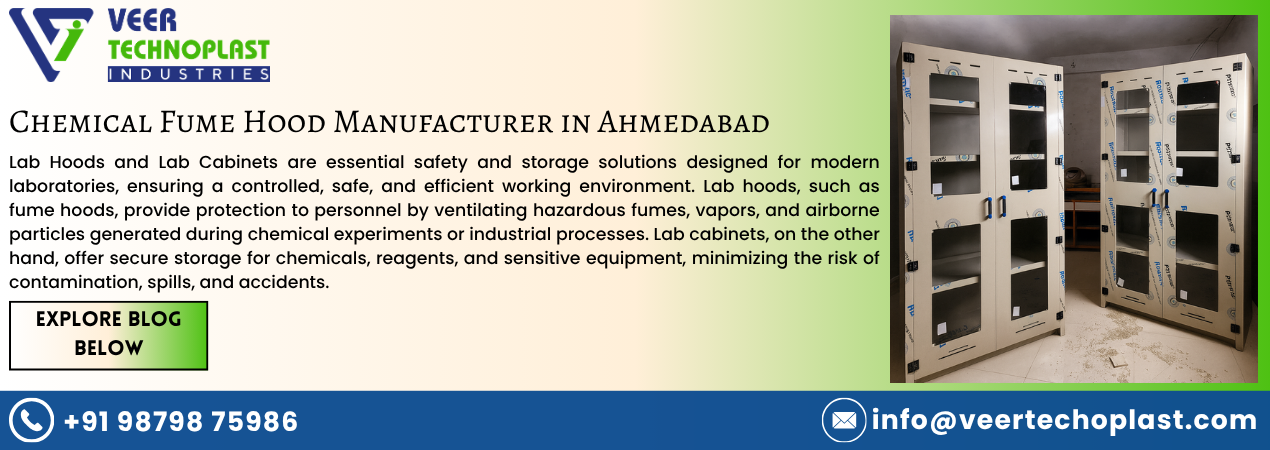
Chemical Fume Hood Manufacturer in Ahmedabad
Chemical Fume Hood Manufacturer in Ahmedabad
Laboratory safety and controlled ventilation systems are essential for industries that handle chemicals, acids, solvents, and hazardous fumes. Chemical fume hoods play a vital role in maintaining a safe working environment by removing harmful vapors, airborne contaminants, and toxic gases generated during laboratory operations. Industries such as pharmaceuticals, chemical processing, biotechnology, research laboratories, educational institutions, and quality testing facilities rely on high-performance laboratory ventilation systems for safety, accuracy, and compliance.
A chemical fume hood is designed to protect laboratory personnel by continuously drawing contaminated air away from the working area. These systems are widely used for chemical reactions, analytical testing, sample preparation, and processes involving hazardous substances. Proper airflow management inside the hood helps maintain a cleaner workspace while reducing exposure risks.
Modern laboratories require durable, corrosion-resistant equipment that can handle aggressive chemicals and long working hours. Chemical fume hoods manufactured using PP, HDPE, FRP, stainless steel, or PP+FRP composite materials provide strong chemical resistance, structural durability, and long service life. These materials are suitable for laboratories where corrosive fumes, acidic vapors, and chemical exposure are common.
Importance of Chemical Fume Hoods in Laboratories
Chemical laboratories generate fumes, vapors, and airborne particles during routine operations. Without proper ventilation, these contaminants can affect worker safety, damage laboratory equipment, and reduce testing accuracy. Chemical fume hoods create a controlled airflow system that safely removes contaminated air from the workspace.
The demand for laboratory fume hoods in Ahmedabad has increased due to the growth of pharmaceutical manufacturing units, research centers, chemical industries, and educational laboratories. Facilities handling hazardous chemicals require efficient exhaust and containment systems to maintain safety standards and improve operational efficiency.
A properly designed chemical fume hood helps laboratories achieve:
- Improved operator safety during chemical handling
- Effective removal of toxic fumes and vapors
- Better contamination control in laboratory environments
- Safe handling of acids, solvents, and reactive compounds
- Enhanced compliance with laboratory safety standards
- Controlled airflow for sensitive laboratory procedures
Construction Materials Used in Chemical Fume Hoods
The performance and durability of a laboratory fume hood depend largely on the materials used in its construction. Different laboratory applications require different levels of chemical resistance, strength, and hygiene.
Polypropylene chemical fume hoods are widely preferred for their excellent resistance to corrosive chemicals, acids, and solvents. PP material is lightweight, durable, and suitable for chemical laboratories that require long-term protection from corrosion.
FRP laboratory hoods are commonly used in industrial environments where mechanical strength and corrosion resistance are both important. HDPE-based systems provide additional durability and are suitable for aggressive chemical handling and high-moisture applications.
Stainless steel laboratory hoods are often selected for cleanroom environments, pharmaceutical laboratories, and applications where hygiene is critical. Their smooth surface finish supports easy cleaning and regular maintenance.
Features of Laboratory Fume Hood Systems
Modern laboratory fume hoods include safety and operational features that improve performance, usability, and protection. These systems are engineered to maintain proper airflow, reduce contamination, and support convenient laboratory work. Important features commonly included in chemical fume hood systems include:
- Chemical-resistant body construction
- Adjustable airflow control systems
- Efficient fume extraction and ventilation
- Integrated LED lighting for better visibility
- Low-noise operational design
- Sash windows for controlled access
- Digital airflow monitoring systems
- HEPA and activated carbon filtration options
- Smooth internal surfaces for easy cleaning
- Customizable dimensions and workstations
The availability of ducted and ductless configurations allows laboratories to choose systems based on their process requirements, available infrastructure, and ventilation needs.
Applications of Chemical Fume Hoods
Chemical fume hoods are used in laboratory and industrial applications where hazardous fumes, vapors, or airborne contaminants are generated. Their ability to provide a controlled working environment makes them essential for several industries.
Pharmaceutical laboratories use fume hoods during chemical formulation, analytical testing, and research processes involving active pharmaceutical ingredients and solvents. Biotechnology facilities depend on controlled airflow systems to support contamination-free operations during experiments and testing procedures. Educational institutions and research centers use laboratory hoods for student experiments, chemical demonstrations, and scientific studies. Chemical manufacturing plants require industrial-grade fume extraction systems to support worker safety during production and quality control operations. Chemical fume hoods are also commonly used in:
- Acid handling laboratories
- Analytical and QC laboratories
- Research and development centers
- Electroplating and anodizing facilities
- Petrochemical laboratories
- Environmental testing labs
- Microbiology laboratories
- Industrial chemical processing units
Laboratory Safety and Ventilation Standards
Maintaining laboratory safety requires more than installing ventilation equipment. Proper airflow design, filtration, and regular maintenance are essential for consistent performance and safe operation.
Face velocity and airflow balancing are important factors in chemical fume hood performance. Controlled airflow helps prevent hazardous fumes from escaping into the laboratory while ensuring efficient exhaust operation.
Advanced laboratory ventilation systems may include airflow alarms, filter monitoring systems, and digital control panels for operational monitoring. HEPA and activated carbon filtration systems are often used in laboratories that require enhanced contaminant removal. Regular inspection and maintenance of fume hood systems help ensure:
- Consistent airflow performance
- Reduced contamination risks
- Safe chemical handling operations
- Extended equipment lifespan
- Improved laboratory efficiency
- Compliance with laboratory safety protocols
Customization Options for Laboratory Hoods
Different laboratory applications require different workspace layouts, airflow capacities, and material specifications. Manufacturers provide customized laboratory fume hood solutions based on industry needs and laboratory design.
Custom laboratory hoods may include integrated sinks, gas taps, reagent shelves, storage cabinets, drainage systems, and specialized work surfaces. Airflow systems can also be designed according to specific laboratory processes and exhaust requirements. Industries handling highly corrosive chemicals often prefer PP or FRP-based customized fume hoods because of their strong resistance properties. Laboratories involved in sensitive analytical work may require low-vibration and low-noise airflow systems for precise operations.
Chemical Fume Hood Demand in Ahmedabad
Ahmedabad has become a major industrial and pharmaceutical hub, creating strong demand for advanced laboratory safety systems. The growth of chemical manufacturing units, pharmaceutical companies, biotechnology research centers, and educational institutions has increased the need for high-quality chemical fume hoods and laboratory cabinets.
Laboratories operating in chemical-intensive industries require durable, corrosion-resistant, and safety-focused ventilation systems that can perform reliably over time. Manufacturers supplying laboratory hoods in Ahmedabad focus on customized solutions for industrial, research, and educational laboratory environments.
The increasing focus on workplace safety, contamination control, and environmental compliance continues to drive demand for efficient laboratory ventilation systems across Gujarat and nearby industrial regions.
FAQs
A chemical fume hood protects laboratory personnel by ventilating hazardous fumes, vapors, and airborne contaminants away from the working area during chemical handling and laboratory operations.
Chemical fume hoods are commonly manufactured using PP, FRP, HDPE, stainless steel, and PP+FRP composite materials due to their corrosion resistance, durability, and suitability for laboratory environments.
Pharmaceutical industries, chemical processing plants, research laboratories, biotechnology facilities, educational institutions, and analytical testing laboratories commonly use laboratory fume hoods.
Ducted fume hoods exhaust contaminated air outside the building through ducting systems, while ductless fume hoods filter the air internally using specialized filtration systems before recirculation.
Proper airflow helps contain and remove hazardous fumes, preventing contaminants from escaping into the laboratory environment and supporting operator safety.
Yes, laboratory fume hoods can be customized with different materials, dimensions, airflow systems, storage cabinets, work surfaces, sinks, and filtration systems according to laboratory requirements.
Chemical-resistant materials such as PP and FRP help prevent corrosion and structural damage caused by aggressive chemicals, ensuring long-term safety and reliable operation.
Get In Touch
Quick Links
Get In Touch
Plot No :- 83, Jyot Industrial Park, Bakrol-dhamatwan Road, Bakrol Bujrang, Ahmedabad, Gujarat -382430
info@veertechnoplast.com
+91 98798 75986
+91 70430 43070
VEER TECHNOPLAST INDUSTRIES | All Rights Reserved.